
The NCP blog
How to Get a Professional Smooth Concrete Finish in Fort Lauderdale
Commercial8 min read
Broward County’s average relative humidity of 74-78% means concrete slabs continuously exchange moisture with the atmosphere.
Achieving a smooth concrete Fort Lauderdale finish requires professional diamond polishing, proper moisture mitigation, and climate-appropriate installation methods. According to the Concrete Polishing Association of America (CPAA), professionally polished concrete surfaces achieve hardness ratings of 7-9 on the Mohs scale, making them more durable than marble or granite. Fort Lauderdale’s unique combination of 76% average humidity, salt air exposure, and year-round temperatures above 80°F demands specialized finishing techniques that differ significantly from northern approaches.
The key to success lies in understanding how Broward County’s coastal environment affects concrete curing, coating adhesion, and long-term performance. This guide covers the specific methods, materials, and professional standards required to achieve factory-smooth results that withstand Florida’s demanding conditions.
Why Fort Lauderdale Concrete Needs Specialized Finishing
Fort Lauderdale sits in USDA Hardiness Zone 10b, where concrete never experiences freeze-thaw cycles but faces constant moisture challenges instead. The National Institute of Standards and Technology (NIST) reports that concrete in high-humidity coastal environments absorbs up to 40% more atmospheric moisture than identical slabs in arid climates. This moisture creates significant obstacles for achieving smooth finishes.
Humidity and Moisture Vapor Transmission
Broward County’s average relative humidity of 74-78% means concrete slabs continuously exchange moisture with the atmosphere. The International Concrete Repair Institute (ICRI) specifies that acceptable moisture vapor emission rates (MVER) must remain below 3 lbs per 1,000 square feet over 24 hours for most coatings. Fort Lauderdale slabs frequently exceed 5 lbs without proper moisture mitigation systems.
ASTM F1869 calcium chloride testing remains the industry standard for measuring MVER. Professional contractors in Fort Lauderdale typically perform multiple tests across large slabs because moisture levels can vary by 30-50% between locations just 10 feet apart.
Salt Air and Chloride Intrusion
Properties within 3 miles of the Atlantic Ocean face accelerated chloride penetration that can compromise concrete integrity. Research from Florida Atlantic University indicates that salt air exposure increases surface efflorescence by 200-300% compared to inland locations. This salt accumulation must be thoroughly removed before any polishing or coating application, or it will cause adhesion failures.
Year-Round High Temperatures
Fort Lauderdale garage floors can reach surface temperatures of 100-120°F during summer months. The Portland Cement Association notes that concrete substrate temperature directly affects coating adhesion, pot life, and curing chemistry. Most epoxy systems require application when substrate temperatures remain between 50-90°F, making timing critical in Fort Lauderdale installations.
Methods for Achieving Smooth Concrete Finishes
Three primary approaches deliver smooth concrete surfaces in Fort Lauderdale: mechanical diamond polishing, self-leveling overlays, and high-build epoxy systems. Each method addresses different starting conditions, budgets, and performance requirements.
Diamond Polishing
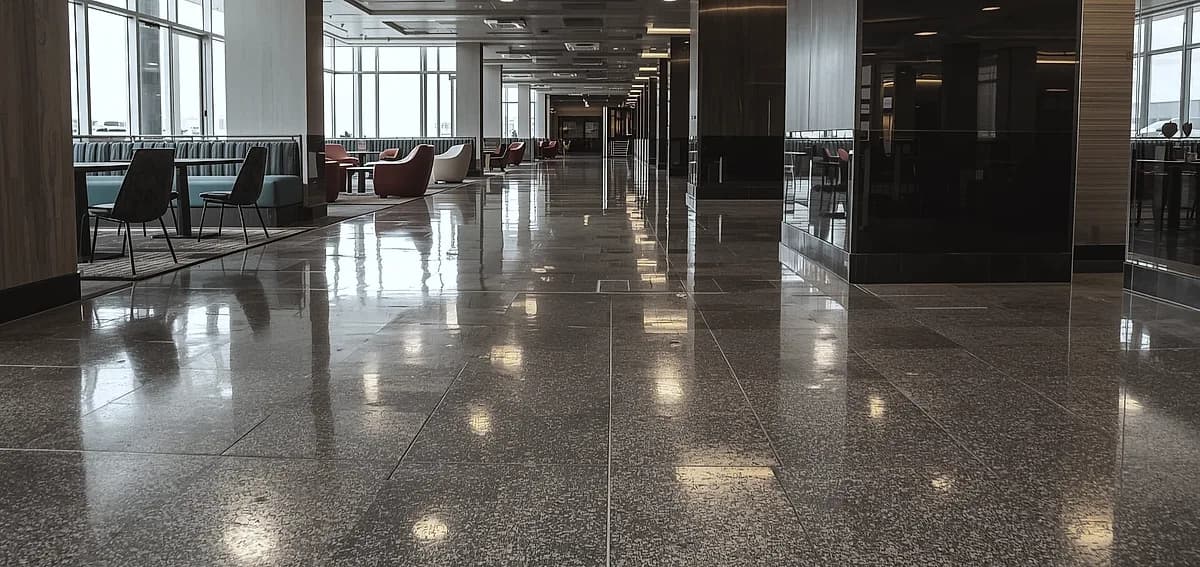
Professional concrete polishing uses progressively finer diamond abrasives to create mirror-like smoothness directly on the concrete surface. The process typically progresses through 6-8 grit stages, starting at 30-50 grit for aggressive material removal and finishing at 1,500-3,000 grit for high-gloss results.
According to the CPAA, polished concrete achieves reflectivity standards measured in gloss units (GU). A matte finish registers 20-40 GU, satin finish 40-70 GU, and high-gloss finish exceeds 70 GU. Fort Lauderdale’s luxury residential market typically requests finishes above 80 GU.
Self-Leveling Overlays
When existing concrete has significant imperfections, self-leveling epoxy underlayment provides a fast path to smooth results. These cementitious or polymer-modified compounds flow across surfaces and seek their own level, eliminating undulations up to 1 inch deep in a single application.
Self-leveling products cure to walkable hardness in 4-6 hours and accept coatings within 24 hours under Fort Lauderdale conditions. The key advantage is speed: contractors can transform a rough, uneven slab into a perfectly flat surface in one day.
High-Build Epoxy Systems
100% solids epoxy floor coatings applied at 10-20 mils thickness create smooth, monolithic surfaces while adding chemical resistance and durability. Unlike water-based alternatives, 100% solids formulations contain no solvents that evaporate during cure, meaning the applied thickness equals the cured thickness.
For maximum smoothness, professional installers apply these systems with notched squeegees calibrated to precise mil thicknesses, then back-roll to eliminate air bubbles and ensure uniform coverage.
Smooth Concrete Finish Options Comparison
The following table compares the primary methods for achieving smooth concrete finishes in Fort Lauderdale:
| Method | Cost/Sq Ft | Timeline | Lifespan | Best For |
|---|---|---|---|---|
| Diamond Polishing | $3-$8 | 3-5 days | 20-25 years | Luxury homes, showrooms |
| Self-Leveling Overlay | $4-$7 | 1-2 days | 10-15 years | Uneven slabs, quick turnaround |
| High-Build Epoxy | $6-$12 | 2-4 days | 15-20 years | Garages, commercial spaces |
| Metallic Epoxy | $8-$15 | 3-5 days | 15-20 years | Designer aesthetics, retail |
Step-by-Step Process for Smooth Concrete in Fort Lauderdale
Professional contractors follow a systematic approach that accounts for Fort Lauderdale’s environmental factors:
Step 1: Comprehensive Moisture Testing
Before any work begins, contractors perform substrate testing using both ASTM F1869 (calcium chloride) and ASTM F2170 (relative humidity probe) methods. The dual-test approach catches moisture issues that single-test methods might miss. Testing locations should include areas near exterior walls, plumbing, and HVAC equipment where moisture accumulation is common.
Step 2: Surface Preparation
Proper surface profiling creates mechanical adhesion points for coatings. The ICRI defines concrete surface profiles (CSP) on a scale of 1-10, with most epoxy systems requiring CSP 2-4. Fort Lauderdale contractors typically achieve this through diamond grinding, which simultaneously removes contaminants and creates optimal texture.
Professional grinding methods use planetary grinders with metal-bond or resin-bond diamond tooling. Metal-bond diamonds work aggressively on hard concrete common in newer Fort Lauderdale construction, while resin-bond diamonds produce finer finishes on softer, older slabs.
Step 3: Moisture Mitigation (If Required)
When moisture testing reveals elevated readings, moisture barriers prevent future coating failures. Two-component epoxy moisture barriers penetrate concrete pores and create impermeable layers that block vapor transmission. These systems typically add $1.50-$3.00 per square foot but prevent costly failures.
Step 4: Densification and Hardening
For polished concrete, chemical densifiers react with calcium hydroxide in the concrete to form calcium silicate hydrate (CSH). This chemical reaction fills microscopic pores, increases surface hardness by 40-60%, and reduces dusting. Lithium silicate densifiers work fastest in Fort Lauderdale’s warm temperatures, achieving full reaction within 24 hours.
Step 5: Progressive Finishing
The final smoothing stage varies by chosen method. Diamond polishing progresses through increasingly finer grits (200, 400, 800, 1500, 3000). Epoxy systems receive multiple coats with light sanding between layers. Metallic epoxy applications require specialized manipulation techniques to create flowing patterns before the material sets.
Step 6: Protective Sealing
Polished concrete receives penetrating guards that resist staining without altering appearance. Epoxy systems receive clear polyurethane or polyaspartic topcoats that add UV resistance, essential for Fort Lauderdale spaces with natural light exposure.
Fort Lauderdale Climate Considerations
Optimal Installation Timing
Fort Lauderdale’s dry season (November through April) provides the most favorable conditions for concrete finishing work. Relative humidity drops to 60-70% during winter months, and temperatures remain within optimal 65-85°F range. The wet season (May through October) requires additional climate control measures, including dehumidification equipment that can add $500-$1,500 to project costs.
Hurricane Season Precautions
Tropical weather systems can introduce sudden humidity spikes that disrupt curing chemistry. The National Hurricane Center’s 5-day forecasts help contractors avoid scheduling installations when storms approach. Professional installers monitor both atmospheric conditions and humidity’s effect on epoxy throughout the curing period.
Air Conditioning Requirements
Running air conditioning during and after installation creates stable temperature and humidity conditions. The system should operate continuously for 72 hours post-installation, maintaining temperatures between 65-75°F and humidity below 60%. This controlled environment ensures consistent curing and optimal bond strength.
Common Problems and Solutions
Surface Dusting
Concrete that produces white powder under traffic indicates insufficient densification or excessive moisture during curing. Solutions include re-application of lithium densifiers or resurfacing with polymer-modified overlays.
Coating Delamination
Epoxy or polyaspartic coatings that bubble or peel typically indicate moisture vapor transmission, insufficient surface preparation, or chemical contamination. The repair process requires complete removal of failed coating, identification of root cause, mitigation measures, and re-application with proper protocols.
Efflorescence
White salt deposits appearing on or under coatings result from moisture carrying dissolved salts to the surface. Fort Lauderdale’s proximity to the ocean makes this particularly common. Prevention requires thorough cleaning with phosphoric acid solutions before coating and proper moisture barrier installation.
Maintenance Requirements for Smooth Concrete
Maintaining smooth concrete finishes in Fort Lauderdale requires routine care adapted to local conditions:
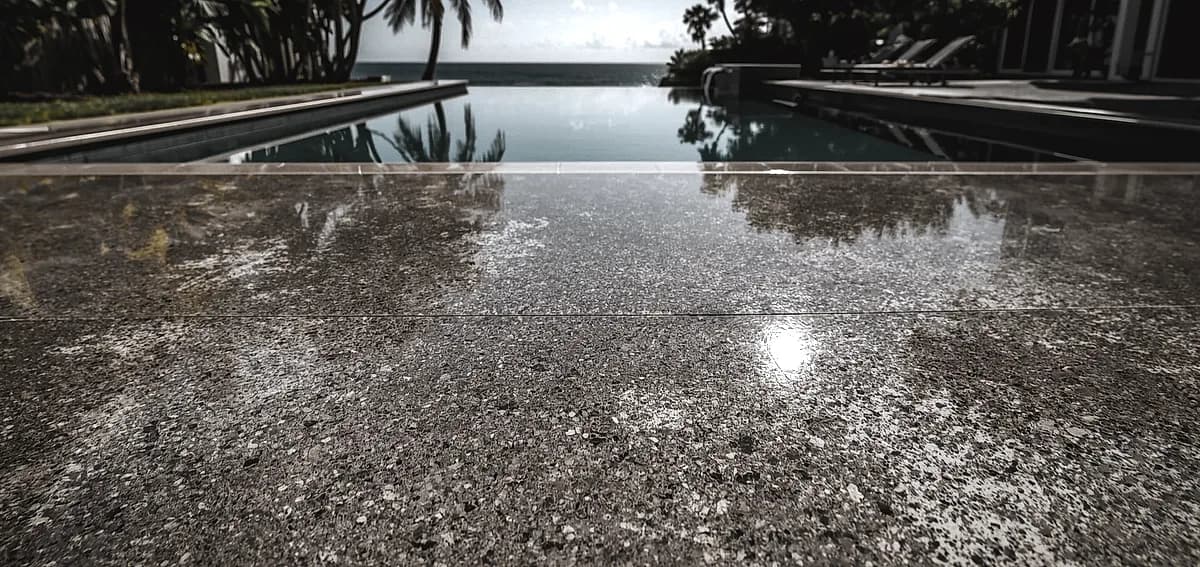
Daily cleaning with dust mops or auto-scrubbers removes sand and debris that act as abrasives. Fort Lauderdale’s constant foot traffic from beaches and outdoor areas makes this especially important.
Weekly mopping with pH-neutral cleaners removes accumulated grime without damaging sealers or coatings. Learn proper techniques in our epoxy floor cleaning guide.
Annual re-application of penetrating guards maintains stain resistance on polished concrete. Coated floors may require topcoat refresh every 3-5 years depending on traffic levels.
Professional inspection every 2-3 years identifies wear patterns, coating thinning, or moisture issues before they become major problems. For comprehensive care guidelines, see our resurfaced concrete maintenance guide.
Frequently Asked Questions
How long does it take to get a smooth concrete finish in Fort Lauderdale?
Timeline varies by method: diamond polishing takes 3-5 days for most residential projects, self-leveling overlays achieve walkable surfaces in 24 hours, and epoxy systems require 2-4 days including cure time. Factor in an additional 1-2 days for moisture mitigation if testing reveals elevated readings.
What is the most durable smooth concrete finish for Fort Lauderdale garages?
For garage applications, polyaspartic coatings offer the best combination of smoothness, durability, and heat resistance. These coatings handle hot tire pickup better than standard epoxies and cure faster in Fort Lauderdale’s humid conditions. Professional systems with UV-stable topcoats last 15-20 years with proper maintenance.
Can old concrete be made smooth in Fort Lauderdale?
Yes. Self-leveling overlays correct imperfections in aged concrete, and diamond grinding removes surface damage. However, severely deteriorated slabs with deep cracks, significant spalling, or structural damage may require concrete resurfacing or full replacement. Professional assessment determines the most cost-effective approach.
How much does smooth concrete cost in Fort Lauderdale?
Costs range from $3-$15 per square foot depending on method and condition of existing concrete. Diamond polishing starts at $3-$8/sq ft, basic epoxy systems at $6-$10/sq ft, and premium metallic epoxy finishes at $8-$15/sq ft. Moisture mitigation adds $1.50-$3.00/sq ft when required.
Is smooth concrete slippery when wet?
High-gloss polished concrete can become slippery when wet. Professional installers address this with anti-slip additives in penetrating guards or by specifying satin finishes (40-70 GU) instead of high-gloss (80+ GU). Epoxy systems can incorporate aluminum oxide or polymer aggregates for slip resistance without sacrificing smoothness.
How do I choose between polished concrete and epoxy for smooth floors?
Choose polished concrete for natural aesthetics, minimal maintenance, and maximum durability in low-chemical environments. Choose epoxy for chemical resistance, color customization, and situations where the existing slab has imperfections that polishing would expose. Fort Lauderdale luxury homes often prefer polished concrete in living areas and epoxy in garages.
Get Professional Smooth Concrete in Fort Lauderdale
National Concrete Polishing delivers factory-smooth concrete finishes throughout Broward County. Our certified installers use commercial-grade equipment and premium materials specifically formulated for Fort Lauderdale’s demanding climate conditions.
With 13+ years of experience in South Florida concrete finishing, we understand the unique challenges of coastal installations. Every project includes comprehensive moisture testing, professional surface preparation, and climate-controlled application for guaranteed results. Contact our Fort Lauderdale team for a free consultation and estimate. We also serve Miami, Pompano Beach, and all of South Florida
Written by

Founder and CEO
Chris Lavin is an esteemed leader in concrete polishing and epoxy coatings with a distinguished 20-year career. As founder and CEO of National Concrete Polishing and owner of Xtreme Polishing Systems, he's renowned for polishing and epoxy coating more floors than anyone globally. Chris is recognized for his innovative approach and commitment to enhancing floor durability and aesthetics. His hands-on experience and technical proficiency make him a respected authority and a valuable resource in the field of floor polishing and coatings.
Same topic
Related articles
All stories
Commercial9 min read
How Polished Concrete Solves Office Acoustic Problems
Hard floors and noise complaints. What polished concrete does to sound in an open office, and how to spec around it.
Read it
Commercial10 min read
Flooring for Hotel Wet Areas, Kitchens, and Parking Decks
Kitchens, pool decks and parking structures punish a floor daily. Which systems hold up in hotel service areas, and why.
Read it
Commercial11 min read
Specifying Floors for a New Hotel Build
For owners and architects on a new build. What to write into the flooring spec so the hotel opens on a floor that lasts.
Read it
Tell us about the floor
Tell us the space and roughly how big it is.We come back with what it would cost and when we could start.
Prefer to talk? Call +1 844-876-5474
- Leads@
nationalconcretepolishing.net - 2200 NW 32nd St #600,
Pompano Beach, FL 33069 Mon to Fri, 9:00 to 5:30