
The NCP blog
Epoxy vs Vinyl Flooring: Best Choice for South Florida Homes
Residential9 min read
South Florida presents the most demanding environment for flooring materials in the continental United States.
When evaluating epoxy flooring vs vinyl flooring for South Florida homes, epoxy consistently outperforms vinyl in moisture resistance, heat tolerance, and long-term durability. The Resilient Floor Covering Institute reports that vinyl flooring experiences 3-4 times higher failure rates in high-humidity coastal environments compared to resinous flooring systems. South Florida’s unique combination of 76% average humidity, salt air exposure, intense UV radiation, and temperatures regularly exceeding 90°F creates conditions that accelerate vinyl degradation while epoxy systems thrive.
This comprehensive comparison examines both flooring types across performance categories critical to homeowners in Miami-Dade, Broward, and Palm Beach counties, providing data-driven insights on durability, installation requirements, maintenance needs, and total cost of ownership.
At-a-Glance Comparison for South Florida
| Performance Factor | Epoxy Flooring | Vinyl Flooring |
|---|---|---|
| Moisture Resistance | Excellent – seamless, impermeable | Moderate – seams allow infiltration |
| Humidity Tolerance | Unaffected by 70-90% RH | Adhesive fails above 70% RH |
| Expected Lifespan | 15-25 years | 5-10 years |
| Heat Tolerance | Stable to 200°F | Softens above 140°F |
| UV Stability | Excellent with UV topcoat | Fades within 3-5 years |
| Salt Air Resistance | Chemically inert, unaffected | Accelerates adhesive breakdown |
| Installation Cost/Sq Ft | $6-$12 | $3-$7 |
| 20-Year Total Cost | $8-$14/sq ft (one installation) | $15-$28/sq ft (2-3 replacements) |
| Best Applications | Garages, kitchens, bathrooms, patios | Climate-controlled bedrooms, offices |
Understanding South Florida’s Climate Challenges
South Florida presents the most demanding environment for flooring materials in the continental United States. Before comparing specific flooring types, understanding these challenges explains why certain materials succeed while others fail prematurely.
Year-Round Humidity
The National Weather Service reports South Florida maintains average relative humidity between 74-78% year-round, with readings frequently exceeding 85% during summer months. This persistent moisture affects both flooring materials and the concrete slabs beneath them.
According to the International Concrete Repair Institute (ICRI), concrete slabs in South Florida emit moisture vapor at rates of 5-8 lbs per 1,000 square feet over 24 hours, well above the 3 lb threshold that causes adhesive failures. Professional moisture testing is essential before any flooring installation.
Coastal Salt Air
Research from Florida Atlantic University indicates that properties within 5 miles of the Atlantic Ocean or Gulf of Mexico experience accelerated material degradation from salt-laden air. Chloride ions penetrate porous materials, causing efflorescence in concrete and breaking down organic adhesives used in vinyl flooring installations.
Understanding how salt air degrades floor coatings helps homeowners select appropriate materials and maintenance protocols for coastal properties.
Intense UV Radiation
South Florida receives approximately 2,800-3,000 hours of direct sunlight annually, roughly 30% more than northern states. The UV index regularly reaches 10-11 (extreme) during summer months. This intense radiation accelerates photodegradation in flooring materials, causing fading, yellowing, and brittleness.
Surface Temperature Extremes
While South Florida’s ambient temperatures remain relatively stable, surface temperatures tell a different story. Garage floors exposed to afternoon sun reach 110-130°F during summer months. Patios and lanais can exceed 140°F. The impact of substrate temperature on flooring performance cannot be overstated.
How Epoxy Flooring Performs in South Florida
Professional epoxy flooring systems are engineered to withstand exactly the conditions South Florida presents. Understanding how epoxy addresses each challenge explains its superior performance in this region.
Moisture and Vapor Management
Epoxy creates a monolithic, seamless surface that prevents moisture infiltration from above. Unlike segmented flooring systems, there are no seams, joints, or edges where water can penetrate.
More importantly, professional installations include moisture barrier systems that block moisture vapor transmission from the concrete slab. Two-component epoxy primers penetrate concrete pores and create impermeable barriers, allowing successful installations even on slabs with elevated moisture readings.
The Portland Cement Association confirms that properly installed epoxy systems with appropriate moisture mitigation show zero moisture-related failures regardless of South Florida’s humidity levels.
Heat and UV Resistance
Industrial-grade epoxy formulations maintain structural integrity at surface temperatures up to 200°F, well above anything South Florida produces. This heat resistance explains why epoxy dominates garage flooring applications where hot tires from sun-heated driveways contact the surface.
Standard amine-cured epoxies can amber (yellow) when exposed to direct UV light. However, professional South Florida installations use UV-stable polyaspartic topcoats that block UV penetration and maintain color stability for 15-20 years even in direct sunlight.
Chemical and Salt Resistance
Cured epoxy is chemically inert, meaning it does not react with salt, chlorides, or other environmental contaminants. According to ASTM testing standards, quality epoxy systems resist automotive fluids, cleaning chemicals, and coastal salt exposure without degradation. Review the complete epoxy chemical resistance chart for specific substance compatibility.
How Vinyl Flooring Performs in South Florida
Vinyl flooring offers attractive aesthetics and lower initial costs, but its construction creates vulnerabilities in South Florida’s demanding environment.
Moisture Vulnerabilities
The National Wood Flooring Association reports that 67% of vinyl flooring failures in coastal Florida result from moisture infiltration at seams. Even luxury vinyl plank (LVP) and luxury vinyl tile (LVT) installations have joints between each piece where moisture can penetrate.
More critically, vinyl adhesives lose 40-60% of their bond strength when relative humidity exceeds 70%. South Florida’s year-round humidity of 74-78% guarantees that vinyl adhesives operate in a compromised state continuously. This explains the significantly shorter lifespan of vinyl installations in this region compared to drier climates.
Unlike epoxy, vinyl cannot receive moisture barrier treatments. The flooring sits on top of the concrete slab without addressing moisture vapor transmission from below, leaving installations vulnerable to adhesive degradation and mold growth.
Heat and UV Limitations
The Tile Council of North America documents that vinyl flooring begins softening at 140°F and experiences permanent deformation above 160°F. South Florida garage floors regularly reach 110-130°F, and hot tires from vehicles parked in sun-heated driveways can exceed vinyl’s deformation threshold, causing permanent indentations and material failure.
Vinyl’s wear layer contains UV stabilizers, but these deplete over 3-5 years of South Florida sun exposure. Once depleted, vinyl fades, yellows, and becomes brittle. Unlike epoxy, which can receive fresh UV-protective topcoats, vinyl requires complete replacement once UV damage occurs.
Salt Air Effects
Salt air accelerates the breakdown of organic adhesives used in vinyl installations. Coastal South Florida properties experience adhesive failure rates 2-3 times higher than inland installations. The combination of salt exposure, humidity, and heat creates a synergistic effect that dramatically shortens vinyl lifespan in beachside communities.
Room-by-Room Recommendations for South Florida Homes
Garages
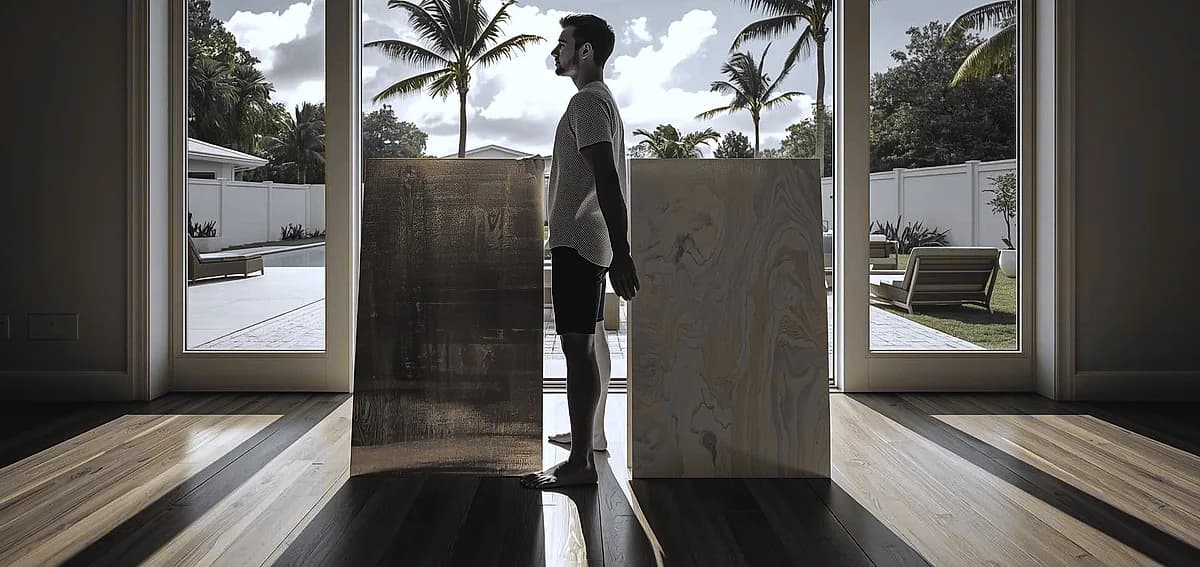
Recommendation: Epoxy only. The combination of hot tire exposure, automotive fluid resistance requirements, and moisture vapor blocking makes epoxy the only practical choice. Professional garage floor coatings with polyaspartic topcoats provide the heat resistance and durability South Florida garages demand.
Kitchens
Recommendation: Epoxy preferred. Kitchen floors face water exposure from cooking and cleaning, chemical exposure from cleaning products, and heavy foot traffic. Epoxy’s seamless installation prevents water from reaching the subfloor, and its chemical resistance handles cleaning products that would damage vinyl. Consider decorative epoxy options that mimic stone or tile aesthetics.
Bathrooms and Laundry Rooms
Recommendation: Epoxy. These rooms experience the highest moisture exposure in any home. Vinyl seams in humid bathroom environments become pathways for water infiltration that leads to mold growth and subfloor damage. Epoxy’s seamless, waterproof surface eliminates these risks entirely.
Living Rooms and Bedrooms
Recommendation: Context-dependent. Climate-controlled living spaces with consistent AC operation may support vinyl installations if homeowners accept the shorter replacement cycle. However, rooms with large windows, frequent door openings, or inconsistent climate control still benefit from epoxy or polished concrete alternatives.
Patios, Lanais, and Pool Decks
Recommendation: Epoxy or polished concrete. Outdoor and semi-outdoor spaces in South Florida face direct sun, rain, and temperature extremes. Vinyl is completely inappropriate for these applications. Epoxy with UV-stable topcoats or concrete resurfacing systems provide the weather resistance these spaces require.
Total Cost of Ownership Analysis
Initial installation costs tell only part of the story. South Florida’s climate dramatically affects long-term costs through replacement frequency and maintenance requirements.
| Cost Component | Epoxy (20 Years) | Vinyl (20 Years) |
|---|---|---|
| Initial Installation | $8,000 (1,000 sq ft @ $8) | $5,000 (1,000 sq ft @ $5) |
| Replacements Required | 0 | 2-3 (every 6-8 years) |
| Replacement Costs | $0 | $14,000-$21,000 |
| Annual Maintenance | $100/year | $250/year |
| 20-Year Total | $10,000 | $24,000-$31,000 |
For detailed pricing breakdowns, see our complete cost to epoxy a floor guide.
Installation Considerations for South Florida
Optimal Installation Timing
South Florida’s dry season (November through April) provides ideal conditions for epoxy installation. Relative humidity drops to 60-70%, temperatures remain moderate, and tropical weather systems are rare. Summer installations require dehumidification equipment that can add $500-$1,500 to project costs.
Understanding how humidity affects epoxy installation helps homeowners schedule projects for optimal results and cost efficiency.
Surface Preparation Requirements
Epoxy requires thorough concrete surface profiling to achieve mechanical adhesion. Professional contractors use diamond grinding or shot blasting to create the texture epoxy needs to bond permanently. This preparation also opens concrete pores for moisture barrier penetration.
Vinyl requires minimal surface preparation, but this creates long-term problems in South Florida. Without proper concrete treatment, moisture vapor continues rising through the slab, eventually degrading vinyl adhesives from below.
Maintenance Requirements Comparison
Epoxy Maintenance in South Florida
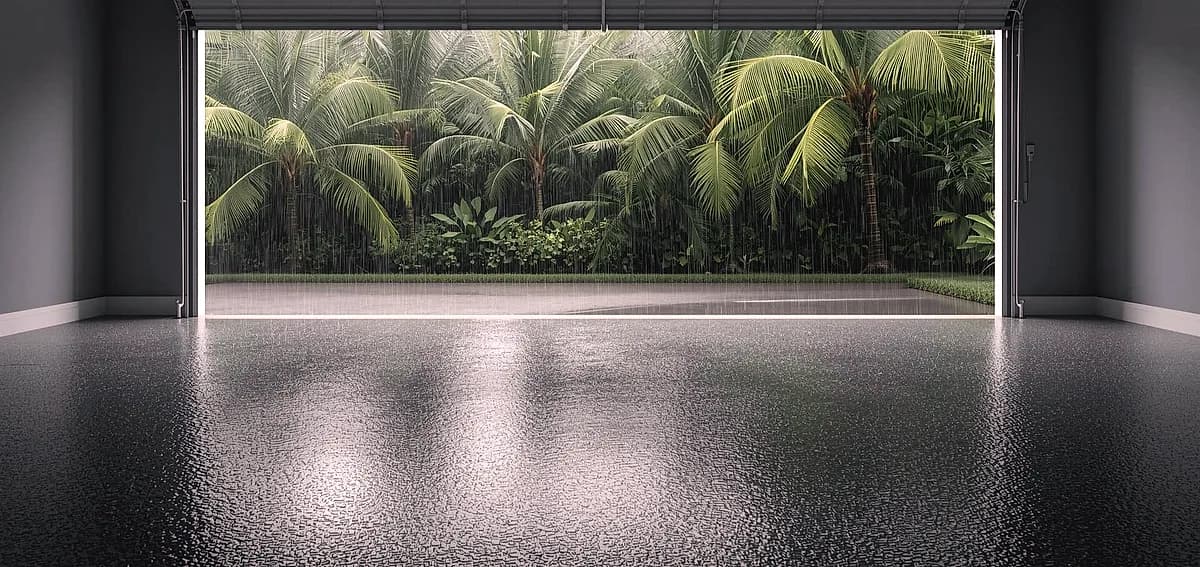
Epoxy floors require minimal ongoing care:
Daily: Dust mop or sweep to remove tracked sand and debris common in South Florida homes near beaches.
Weekly: Damp mop with pH-neutral cleaner. See our epoxy floor cleaning guide for recommended products.
Every 5-7 years: Optional clear topcoat refresh to restore gloss and UV protection.
Vinyl Maintenance in South Florida
Vinyl requires more intensive care, particularly in humid environments:
Daily: Sweep and spot clean. Avoid excessive water that infiltrates seams.
Weekly: Damp mop with vinyl-specific cleaners only. Harsh chemicals damage wear layers.
Monthly: Inspect seams for lifting, buckling, or moisture damage. Address immediately.
Annually: Professional deep cleaning and seam inspection. Wax application for commercial vinyl.
Every 6-10 years: Complete replacement due to wear, fading, or moisture damage.
Frequently Asked Questions
Is epoxy flooring worth the higher upfront cost in South Florida?
Yes. While epoxy costs $6-$12 per square foot compared to vinyl’s $3-$7, epoxy’s 15-25 year lifespan in South Florida means one installation versus 2-3 vinyl replacements. Over 20 years, epoxy costs approximately $10,000 for a 1,000 square foot space, while vinyl costs $24,000-$31,000 including replacements. The higher upfront investment delivers significant long-term savings.
Can vinyl flooring survive in South Florida garages?
No. Vinyl softens and deforms at temperatures above 140°F. South Florida garage floors reach 110-130°F in summer, and hot tires from sun-heated driveways exceed vinyl’s deformation threshold. Additionally, automotive fluids damage vinyl surfaces. Epoxy is the only practical garage flooring choice for South Florida homes.
Why does vinyl fail faster in South Florida than other regions?
South Florida’s 74-78% average humidity exceeds the 70% threshold where vinyl adhesives begin losing bond strength. Combined with salt air exposure that degrades organic adhesives, intense UV radiation that depletes wear layer stabilizers, and high surface temperatures, vinyl faces multiple degradation mechanisms simultaneously. These factors combine to reduce vinyl lifespan from 15-20 years in temperate climates to just 5-10 years in South Florida.
Is luxury vinyl plank (LVP) better than standard vinyl for South Florida?
LVP offers improved aesthetics and slightly better durability than standard vinyl, but shares the same fundamental vulnerabilities: seams that allow moisture infiltration, adhesives that degrade in high humidity, and wear layers that break down under UV exposure. LVP may extend vinyl’s South Florida lifespan from 5-7 years to 8-10 years, but still falls far short of epoxy’s 15-25 year performance.
What about waterproof vinyl flooring?
Marketing claims of “waterproof” vinyl are misleading. While the vinyl material itself resists water, vinyl flooring systems are not waterproof. Seams between planks or tiles still allow water infiltration, and adhesives still degrade in humidity above 70%. Additionally, “waterproof” vinyl cannot address moisture vapor transmission from concrete slabs, which remains the primary moisture concern in South Florida installations.
Which flooring type is better for South Florida rental properties?
Epoxy provides better value for South Florida rentals despite higher upfront costs. Landlords avoid replacement hassles and tenant disruption, maintenance requirements are minimal, and the flooring survives the increased wear of rental turnover. The commercial-grade durability of professional epoxy systems handles tenant abuse far better than vinyl’s wear layer.
Get Professional Epoxy Flooring in South Florida
National Concrete Polishing provides expert epoxy flooring installation throughout South Florida. Our certified installers understand the unique challenges of tropical climates and use premium materials specifically formulated for high-humidity, high-heat environments.
Every installation includes comprehensive moisture testing, professional surface preparation, and UV-stable topcoats for guaranteed long-term performance in South Florida conditions.
Contact our South Florida team for a free consultation. We serve Miami, Fort Lauderdale, Pompano Beach, Port St. Lucie, and all surrounding areas.
Written by

Founder and CEO
Chris Lavin is an esteemed leader in concrete polishing and epoxy coatings with a distinguished 20-year career. As founder and CEO of National Concrete Polishing and owner of Xtreme Polishing Systems, he's renowned for polishing and epoxy coating more floors than anyone globally. Chris is recognized for his innovative approach and commitment to enhancing floor durability and aesthetics. His hands-on experience and technical proficiency make him a respected authority and a valuable resource in the field of floor polishing and coatings.
Same topic
Related articles
All stories
Residential8 min read
What Restaurants Need to Pass a Health Inspection Floor Check
It endures heavy foot traffic, dropped equipment, boiling water spills, and harsh degreasing chemicals daily.
Read it
Residential9 min read
How Restaurants Replace Their Floors Without Closing for Long
The average food service establishment loses approximately $3,500 in daily revenue during unexpected closures in 2026.
Read it
Residential8 min read
Where Polished Concrete Beats Epoxy in a Home (and Where It Doesn’t)
Before evaluating specific rooms, it is essential to understand how these two flooring systems function.
Read it
Tell us about the floor
Tell us the space and roughly how big it is.We come back with what it would cost and when we could start.
Prefer to talk? Call +1 844-876-5474
- Leads@
nationalconcretepolishing.net - 2200 NW 32nd St #600,
Pompano Beach, FL 33069 Mon to Fri, 9:00 to 5:30