
The NCP blog
Comparing Epoxy and Vinyl Flooring for Fort Lauderdale Properties
Epoxy & coatings13 min read
However, vinyl remains a floating or glued-down system that sits on top of the subfloor rather than integrating with it.
For Fort Lauderdale property owners, the choice between epoxy and vinyl flooring comes down to one critical factor: moisture management. Epoxy forms a seamless, impermeable barrier that bonds directly to concrete, making it the superior choice for garages, basements, and commercial spaces exposed to humidity and occasional flooding. Luxury vinyl plank offers a faster, more affordable installation with endless design options, but it remains vulnerable to moisture intrusion at the seams. Understanding this fundamental difference will save you from costly repairs and premature replacement in South Florida’s subtropical climate.
Understanding the Core Materials
Epoxy flooring is a thermosetting polymer system consisting of resin and hardener components that, when mixed, undergo a chemical reaction to form a rigid, cross-linked plastic material. This reaction creates a bond at the molecular level with the concrete substrate, effectively becoming part of the slab itself. According to the American Concrete Institute, properly installed epoxy coatings exhibit compressive strengths exceeding 10,000 psi, far surpassing standard concrete. The system typically includes a primer coat, one or more body coats, and a UV-stable topcoat to prevent yellowing from Fort Lauderdale’s intense sunlight.
Vinyl flooring, by contrast, is a manufactured product composed of multiple layers of polyvinyl chloride (PVC) fused together under heat and pressure. Modern luxury vinyl plank (LVP) features a high-resolution photographic layer that mimics wood, stone, or tile, protected by a clear wear layer measured in mils (thousandths of an inch). The U.S. Environmental Protection Agency notes that vinyl flooring manufacturing has evolved significantly, with phthalate-free formulations now dominating the market. However, vinyl remains a floating or glued-down system that sits on top of the subfloor rather than integrating with it.
Moisture Resistance: The Fort Lauderdale Deciding Factor
Fort Lauderdale’s average relative humidity hovers around 75% year-round, with summer months frequently exceeding 90%. This moisture load penetrates concrete slabs through hydrostatic pressure and vapor transmission, creating a hostile environment for many flooring materials. Epoxy flooring addresses this challenge at the source. A moisture-mitigating epoxy primer penetrates the concrete’s capillary pores, reducing moisture vapor transmission rates to below 3 pounds per 1,000 square feet per 24 hours—the threshold recognized by the ASTM F2170 standard for flooring installations.
Vinyl flooring, even when labeled as waterproof, faces a fundamental limitation: the planks themselves resist water, but the seams between them do not. Research from the National Association of Home Builders indicates that water intrusion through vinyl plank seams accounts for 23% of flooring failures in coastal regions. Once moisture becomes trapped between the vinyl and the concrete slab, it creates an ideal breeding ground for mold and bacteria. As Dr. Elena Torres, Building Science Researcher at the University of Florida, explains: “In subtropical climates, we consistently observe elevated spore counts beneath vinyl flooring installations within 18 months when vapor barriers are compromised or absent.”
Durability and Longevity Comparison
Epoxy flooring delivers exceptional durability that translates directly to long-term value. A properly installed epoxy system withstands impact forces up to 12,000 psi, resists staining from automotive fluids, and maintains its gloss level for over a decade with minimal maintenance. The National Floor Safety Institute reports that quartz-filled epoxy systems achieve a coefficient of friction exceeding 0.6 when wet, meeting OSHA safety standards for commercial environments. In Fort Lauderdale’s coastal environment, epoxy’s resistance to salt air corrosion makes it particularly valuable for waterfront properties and marine applications.
Vinyl flooring offers good durability for residential foot traffic but shows significant wear patterns under heavier loads. The wear layer thickness determines longevity: a 20-mil wear layer typically provides 15-20 years in low-traffic areas, while a 6-mil layer may show visible wear within 5 years. Heavy furniture, pet claws, and dropped objects can permanently indent or tear vinyl planks. Marcus Chen, Flooring Specialist with 22 years of experience in South Florida installations, states: “I’ve pulled up five-year-old vinyl floors in Fort Lauderdale homes that looked ten years older due to humidity cycling. The expansion and contraction breaks down the locking mechanisms over time.”
| Performance Factor | Epoxy Flooring | Vinyl Flooring |
|---|---|---|
| Lifespan | 15-25 years | 10-15 years (residential) |
| Impact Resistance | Excellent (12,000+ psi) | Moderate (dents from heavy objects) |
| Moisture Protection | Seamless, integral barrier | Seam-dependent, risk of subfloor moisture |
| UV Stability | Requires UV topcoat | Good with UV-cured urethane layer |
| Chemical Resistance | Superior (acids, solvents, oils) | Limited (stains from harsh chemicals) |
| Repairability | Spot repairs possible | Plank replacement required |
Installation Process and Time Requirements
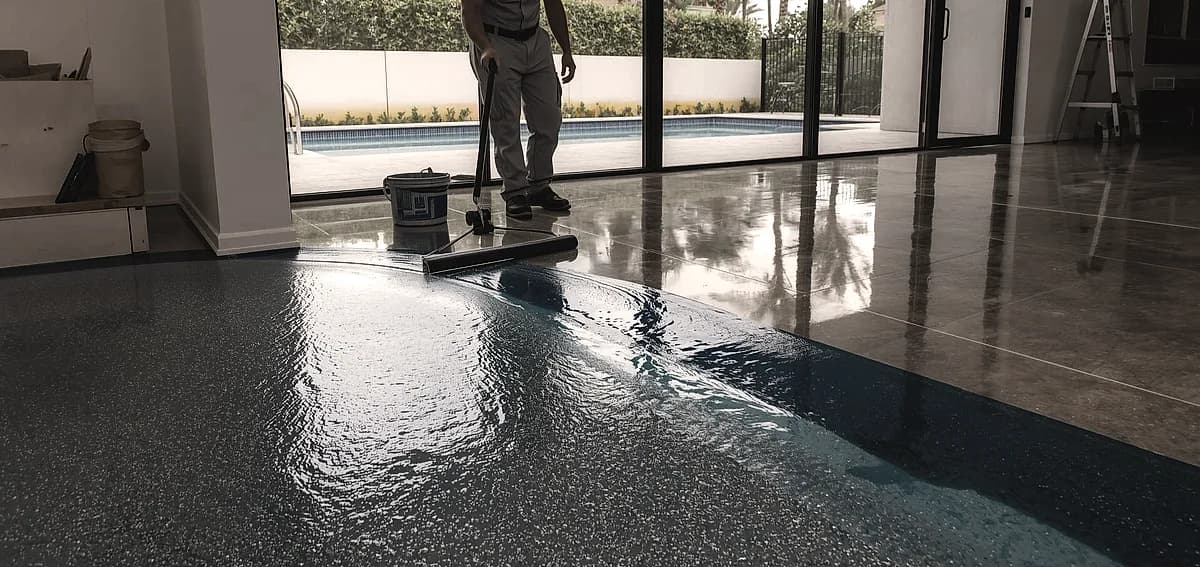
Epoxy flooring installation is a multi-stage process that demands meticulous surface preparation. The concrete must be profiled through diamond grinding or shot blasting to achieve a CSP (Concrete Surface Profile) of 2-4, as defined by the International Concrete Repair Institute. This creates the mechanical anchor profile necessary for the epoxy to bond. Any existing moisture issues must be addressed through proper waterproofing measures before application begins. The typical timeline spans 3-5 days for a standard two-car garage, including 24-hour cure windows between coats.
Vinyl flooring installation proceeds much faster, often completing a 500-square-foot room in a single day. The subfloor must be flat within 3/16 inch over a 10-foot span, which may require concrete floor leveling before installation. Floating floors require an underlayment for moisture protection and sound reduction, while glue-down installations demand a dry, clean substrate. The click-lock systems used in modern LVP allow for immediate occupancy, though manufacturers recommend a 48-hour acclimation period for the material to adjust to the room’s temperature and humidity.
Cost Analysis: Upfront vs. Lifetime Value
The initial investment for epoxy flooring in Fort Lauderdale ranges from $4 to $12 per square foot for professional installation, depending on the system complexity. A basic solid-color epoxy with a clear topcoat falls at the lower end, while metallic epoxy systems with multiple color layers and decorative flakes reach the premium tier. Vinyl flooring installation costs between $2 and $7 per square foot, with the material itself accounting for 40-60% of the total. At first glance, vinyl appears significantly cheaper.
However, a 20-year cost analysis reveals a different picture. According to data from the Building Owners and Managers Association, epoxy flooring requires only periodic cleaning and occasional re-coating of the topcoat every 7-10 years, at approximately $1.50 per square foot. Vinyl flooring typically requires complete replacement within 12-15 years in humid environments, effectively doubling the initial cost over the same period. When factoring in the potential for subfloor mold remediation—which averages $2,500 per incident according to the Environmental Protection Agency—the total cost of ownership strongly favors epoxy for any space exposed to moisture.
Aesthetic Options and Design Flexibility
Vinyl flooring dominates the design conversation with its photographic realism. Modern LVP replicates the grain patterns of exotic hardwoods, the veining of Carrara marble, and the texture of hand-scraped hickory with remarkable fidelity. The design layer is protected by a clear wear layer that can include embossed-in-register texture, meaning the surface texture aligns perfectly with the visual pattern. For Fort Lauderdale homeowners seeking the look of wide-plank European oak without the maintenance concerns, vinyl delivers an immediately satisfying result.
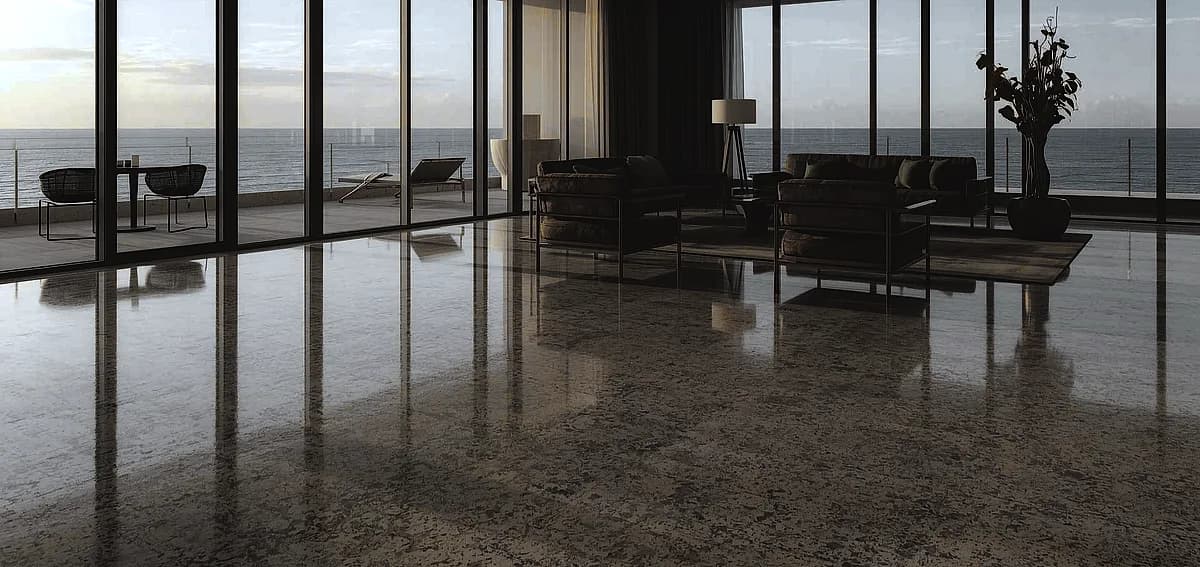
Epoxy flooring offers a different kind of aesthetic: depth and luminosity. Metallic epoxy systems, which have gained significant traction in South Florida’s luxury market, use pigments that create a three-dimensional, marbled effect impossible to achieve with printed materials. The light reflects through multiple translucent layers, producing a sense of movement and depth that changes throughout the day. Solid-color epoxy with decorative flake broadcasts provides a terrazzo-like appearance that works exceptionally well in mid-century modern Fort Lauderdale homes. For commercial applications, epoxy can incorporate safety markings, color-coded zones, and high-gloss finishes that enhance lighting efficiency by up to 30%, as noted by the Illuminating Engineering Society.
Maintenance Requirements and Daily Care
Epoxy flooring maintenance is straightforward: dust mopping or vacuuming removes surface debris, and damp mopping with a pH-neutral cleaner handles spills and stains. The seamless surface prevents dirt from accumulating in crevices, making it a hygienic choice for allergy sufferers. The American Lung Association recognizes hard-surface flooring for its role in reducing indoor allergen levels. For commercial epoxy floor cleaning, auto-scrubbers with soft pads maintain the gloss without damaging the surface. One critical maintenance note: avoid abrasive cleaners and steel wool, which can dull the finish over time.
Vinyl flooring requires more attentive care. While the wear layer resists scratches, it can be permanently stained by rubber-backed mats, asphalt tracking, and certain dyes. The National Wood Flooring Association recommends felt pads under all furniture legs and immediate cleanup of spills to prevent moisture from seeping into seams. Steam mops, popular for their sanitizing capability, can delaminate vinyl planks and void manufacturer warranties. In Fort Lauderdale’s sandy environment, frequent sweeping prevents grit from acting as sandpaper on the wear layer, gradually eroding the protective surface.
Environmental and Health Considerations
The environmental profiles of these materials differ substantially. Epoxy flooring, once cured, is chemically inert and emits zero volatile organic compounds (VOCs). The installation process, however, releases VOCs during the curing phase, requiring proper ventilation and respirator use for installers. Low-VOC and zero-VOC epoxy formulations have become standard in the industry, with products meeting LEED v4.1 low-emitting materials criteria. The longevity of epoxy means less frequent replacement and lower lifecycle environmental impact. For a deeper analysis, review our article on epoxy flooring environmental impact.
Vinyl flooring manufacturing has made significant strides in reducing harmful plasticizers. The Vinyl Institute reports that phthalate-free formulations now represent over 90% of the North American LVT market. However, vinyl remains a petroleum-based product with limited end-of-life recycling options. The U.S. Green Building Council notes that vinyl flooring can contribute to LEED credits for recycled content when manufacturers incorporate post-industrial waste, but the material ultimately ends up in landfills at the end of its service life. For Fort Lauderdale residents concerned about indoor air quality, third-party certifications like FloorScore and GREENGUARD Gold provide assurance of low chemical emissions.
Specific Applications: Where Each Material Excels
Epoxy flooring is the definitive choice for garages, workshops, and commercial spaces in Fort Lauderdale. The chemical resistance handles gasoline spills, battery acid, and brake fluid without staining or degradation. For garage epoxy flooring in Fort Lauderdale, the seamless surface prevents oil and chemicals from penetrating the concrete slab, protecting the underlying structure. Commercial kitchens benefit from epoxy’s compliance with commercial kitchen floor regulations, including slip resistance and sanitary seamless surfaces. Medical facilities, industrial plants, and retail showrooms all leverage epoxy’s durability and ease of cleaning.
Vinyl flooring shines in residential living areas, bedrooms, and home offices where comfort and aesthetics take priority over extreme durability. The slight resilience of vinyl reduces leg fatigue for standing tasks and provides a warmer feel underfoot compared to concrete-based flooring. For Fort Lauderdale condominiums with strict sound transmission requirements, vinyl’s acoustic properties help meet building code standards. Rental properties and quick-turnaround renovations also benefit from vinyl’s rapid installation and immediate usability. However, for any area below grade or in direct contact with a concrete slab, understanding the moisture risks is essential before committing to vinyl.
Common Installation Mistakes and How to Avoid Them
Epoxy flooring failures almost always trace back to inadequate surface preparation. The concrete must be free of curing compounds, sealers, oils, and laitance—the weak surface layer that forms during concrete finishing. A common mistake is relying on acid etching instead of mechanical profiling; acid etching does not create a consistent surface profile and can leave residues that interfere with adhesion. For guidance on proper preparation, consult our epoxy floor prep checklist. Another critical error is ignoring epoxy primer adhesion testing before full application. A simple pull-off test per ASTM D4541 confirms that the substrate will support the coating system.
Vinyl flooring installations fail most frequently due to moisture and flatness issues. Installers sometimes skip moisture testing, assuming that the “waterproof” label on the box eliminates the need for vapor barrier considerations. In Fort Lauderdale, a calcium chloride test per ASTM F1869 should always precede vinyl installation over concrete. Floor flatness deviations exceeding the manufacturer’s tolerance create voids under the planks, leading to clicking sounds, joint separation, and accelerated wear. As Sarah Lindstrom, Certified Flooring Inspector with the National Institute of Certified Floorcovering Inspectors, notes: “I see more vinyl flooring claims in South Florida than any other region. The combination of humidity and rushed installations creates a perfect storm for failure.”
Repair and Restoration Options
Epoxy flooring repairs are localized and permanent. Surface scratches can be buffed out with a polishing compound, while deeper gouges are filled with a color-matched epoxy patching compound and re-topcoated. The repair blends seamlessly because the new epoxy chemically bonds with the existing coating. For extensive damage, the affected area is ground down to bare concrete and recoated, with the repair edges feathered into the surrounding floor. Our guide on the epoxy floor repair process details the steps for professional restoration.
Vinyl flooring repairs require plank replacement, which presents matching challenges. Even if you saved original planks from the installation, the installed floor will have faded or changed color slightly due to UV exposure and wear. The locking mechanisms on replacement planks must be carefully trimmed to fit, often requiring adhesive to secure the new piece. For glue-down vinyl, the old adhesive must be completely removed before installing the replacement, a time-consuming800 process that can damage adjacent planks if not performed carefully.
Frequently Asked Questions
Can epoxy flooring be installed over existing vinyl flooring?
No, epoxy cannot bond to vinyl surfaces. The existing vinyl flooring must be completely removed, and the concrete substrate must be properly prepared through grinding or shot blasting before epoxy application. Installing epoxy over vinyl will result in delamination and complete system failure within months.
Which flooring is better for homes with pets in Fort Lauderdale?
Epoxy flooring is superior for pet-friendly homes. Its seamless surface resists scratches from claws, does not absorb pet accidents, and eliminates the hiding places for fleas and allergens that exist in vinyl plank seams. The non-porous surface also prevents odors from penetrating the floor.
How does Fort Lauderdale’s humidity affect epoxy curing?
High humidity can cause amine blush—a waxy surface film that forms when epoxy reacts with atmospheric moisture during curing. Professional installers monitor dew point and relative humidity, using dehumidifiers when necessary to maintain conditions within the manufacturer’s specified range, typically below 75% relative humidity.
Is vinyl flooring truly waterproof?
Vinyl plank material itself is waterproof, but the installed floor system is only water-resistant. Water can penetrate through seams, edges, and perimeter gaps, becoming trapped between the vinyl and the subfloor. This trapped moisture leads to mold growth, adhesive breakdown, and subfloor damage over time.
What is the ROI comparison for rental properties?
For Fort Lauderdale rental properties, epoxy flooring in garages and common areas reduces turnover maintenance costs by approximately 40% compared to vinyl, according to data from the National Apartment Association. The durability and ease of cleaning minimize damage deposits and vacancy periods for floor repairs.
Can I install either flooring type myself?
Vinyl plank flooring is accessible to experienced DIYers with proper subfloor preparation. Epoxy flooring installation requires professional equipment, chemical handling knowledge, and understanding of concrete surface preparation. DIY epoxy kits rarely achieve the durability of professional-grade systems and often fail within 1-2 years.
Which flooring option is more slip-resistant when wet?
Epoxy flooring can be formulated with aggregate additives like aluminum oxide or quartz to achieve specific slip-resistance ratings. Vinyl flooring’s slip resistance depends entirely on the embossed texture of the wear layer, which cannot be modified after manufacturing. Both can meet ADA slip-resistance requirements when properly specified.
How do these flooring types affect home resale value in Fort Lauderdale?
Epoxy garage floors and polished concrete finishes are increasingly viewed as premium features in the South Florida real estate market. A 2026 survey by the National Association of Realtors found that upgraded garage flooring recovers 65-80% of its cost at resale. Vinyl flooring in living areas is considered a standard finish and does not significantly impact appraised value.
Conclusion
The decision between epoxy and vinyl flooring for Fort Lauderdale properties ultimately hinges on the specific space and its exposure to moisture. Epoxy flooring delivers unmatched durability, seamless moisture protection, and20-year-plus service life that justifies its higher initial investment for garages, basements, commercial spaces, and any area in direct contact with a concrete slab. Vinyl flooring provides a comfortable, design-flexible solution for interior living spaces where moisture16 is controlled and rapid installation is a priority. For most Fort Lauderdale property owners, the optimal strategy combines both materials: epoxy in moisture-prone and high-wear zones, vinyl in climate-controlled living areas. To discuss your specific project requirements and receive a professional assessment of your space, contact our flooring specialists today for a consultation tailored to Fort Lauderdale’s unique climate challenges.
References
- American Concrete Institute. Concrete Surface Preparation Standards
- ASTM International. ASTM F2170 Standard Test Method for Determining Relative Humidity in Concrete Floor Slabs
- Building Owners and Managers Association International. Flooring Lifecycle Cost Analysis
- National Association of Home Builders. Coastal Construction Best Practices
- National Floor Safety Institute. Floor Safety Standards and Testing
- U.S. Environmental Protection Agency. Indoor Air Quality and Flooring Materials
- Vinyl Institute. Phthalate-Free Vinyl Flooring
- International Concrete Repair Institute. Concrete Surface Profile Guidelines
Written by

Founder and CEO
Chris Lavin is an esteemed leader in concrete polishing and epoxy coatings with a distinguished 20-year career. As founder and CEO of National Concrete Polishing and owner of Xtreme Polishing Systems, he's renowned for polishing and epoxy coating more floors than anyone globally. Chris is recognized for his innovative approach and commitment to enhancing floor durability and aesthetics. His hands-on experience and technical proficiency make him a respected authority and a valuable resource in the field of floor polishing and coatings.
Same topic
Related articles
All stories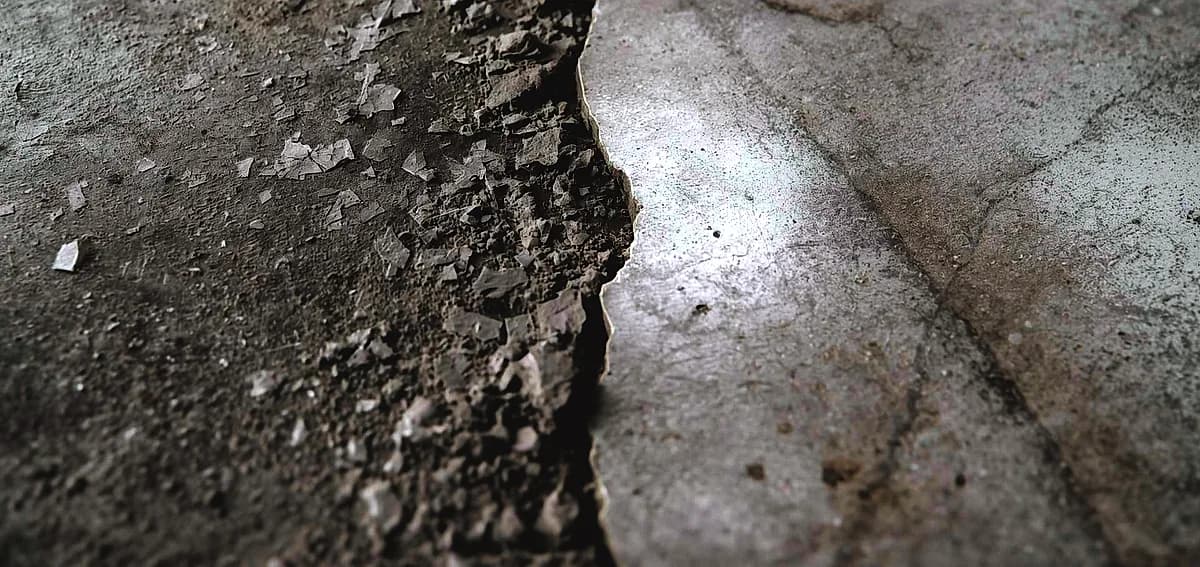
Epoxy & coatings8 min read
DIY vs Professional Epoxy Flooring in Fort Lauderdale
Hardware stores heavily market all-in-one boxes that promise a showroom finish with minimal effort.
Read it
Epoxy & coatings8 min read
Can You DIY Epoxy Flooring in Miami? Pros, Cons, and Tips
Applying a durable floor finish in a tropical or highly humid climate presents unique environmental challenges.
Read it
Epoxy & coatings7 min read
DIY Epoxy Flooring in South Florida: Is It Worth the Risk?
However, these products generally contain high levels of water or solvents to extend their pot life.
Read it
Tell us about the floor
Tell us the space and roughly how big it is.We come back with what it would cost and when we could start.
Prefer to talk? Call +1 844-876-5474
- Leads@
nationalconcretepolishing.net - 2200 NW 32nd St #600,
Pompano Beach, FL 33069 Mon to Fri, 9:00 to 5:30