
The NCP blog
Grounding Requirements for Floors in Fort Lauderdale Electronics Facilities
Commercial5 min read
A discharge as small as 20 volts can damage microelectronic components, yet humans cannot feel discharges below 3,500 volts.
Fort Lauderdale’s growing electronics manufacturing sector demands specialized flooring solutions that protect sensitive components from electrostatic discharge. Epoxy floor grounding electronics facilities require precise installation techniques and strict adherence to industry standards to prevent costly equipment damage. Electronics manufacturers throughout Broward County—from printed circuit board assemblers to semiconductor distributors—rely on properly grounded commercial epoxy flooring systems to safeguard their operations.
Static electricity poses a serious threat in electronics environments. A discharge as small as 20 volts can damage microelectronic components, yet humans cannot feel discharges below 3,500 volts. This gap creates invisible hazards that grounded epoxy flooring systems eliminate.
Understanding ESD Flooring Standards
ANSI/ESD S20.20-2021 Requirements
The ANSI/ESD S20.20-2021 standard serves as the foundation for electrostatic discharge control in electronics facilities. This internationally recognized standard applies to organizations handling electronic components susceptible to damage from discharges of 100 volts or greater.
For flooring, the standard references three critical test methods. ANSI/ESD STM7.1 requires resistance below 1.0 x 10⁹ ohms to ground. ANSI/ESD STM97.1 evaluates the combined resistance of floor materials and footwear with a person, recommending maximum system resistance of 3.5 x 10⁹ ohms. ANSI/ESD STM97.2 measures walking voltage generation, with a maximum of 100 volts recommended.
Electronics facilities seeking commercial epoxy floors should work with contractors who understand these specifications.
Conductive Versus Static Dissipative Flooring
Conductive flooring measures below 1.0 x 10⁶ ohms and provides fastest charge dissipation—suitable for semiconductor fabrication environments. Static dissipative flooring falls between 1.0 x 10⁶ and 1.0 x 10⁹ ohms, offering effective ESD protection while reducing shock hazards.
The ideal resistance range for most electronics applications falls between 10⁵ and 10⁸ ohms. Fort Lauderdale facilities should select flooring based on equipment sensitivity rather than defaulting to the most conductive option. Proper floor preparation ensures target resistance values are achieved.
Grounding System Components
Copper Grounding Strips
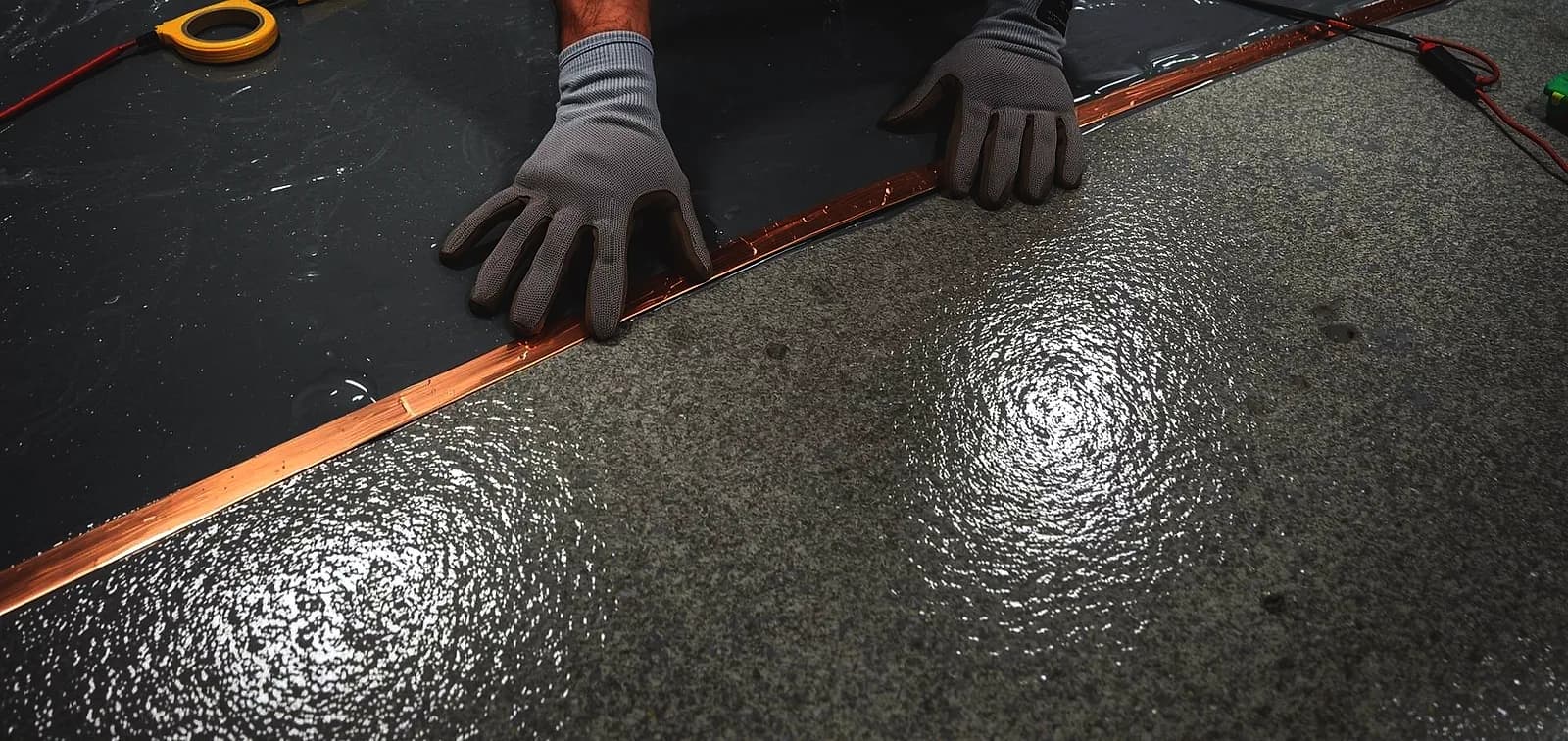
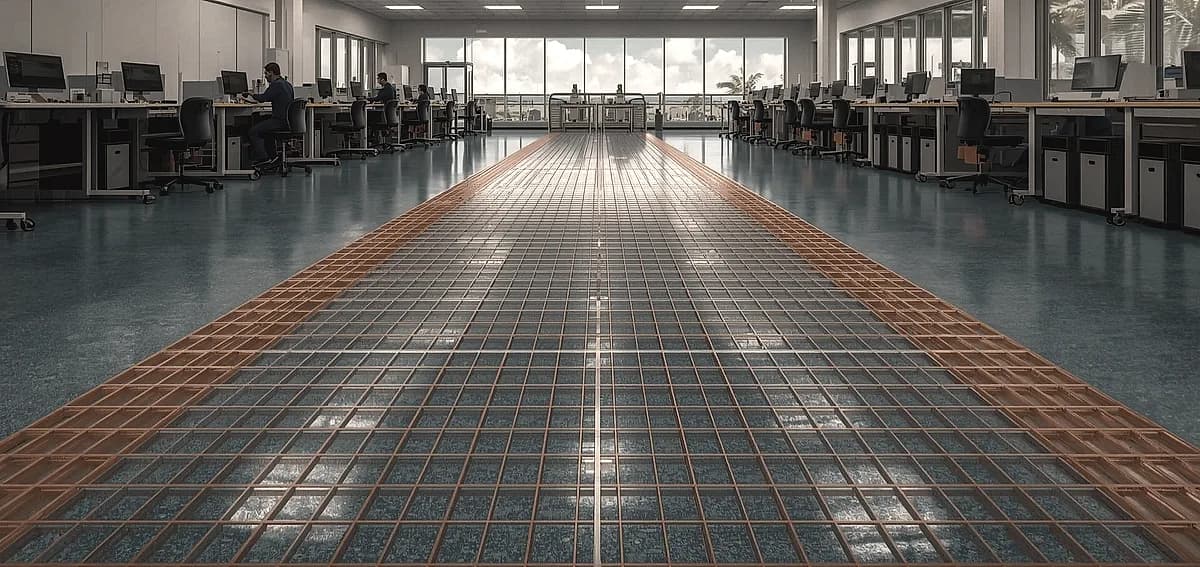
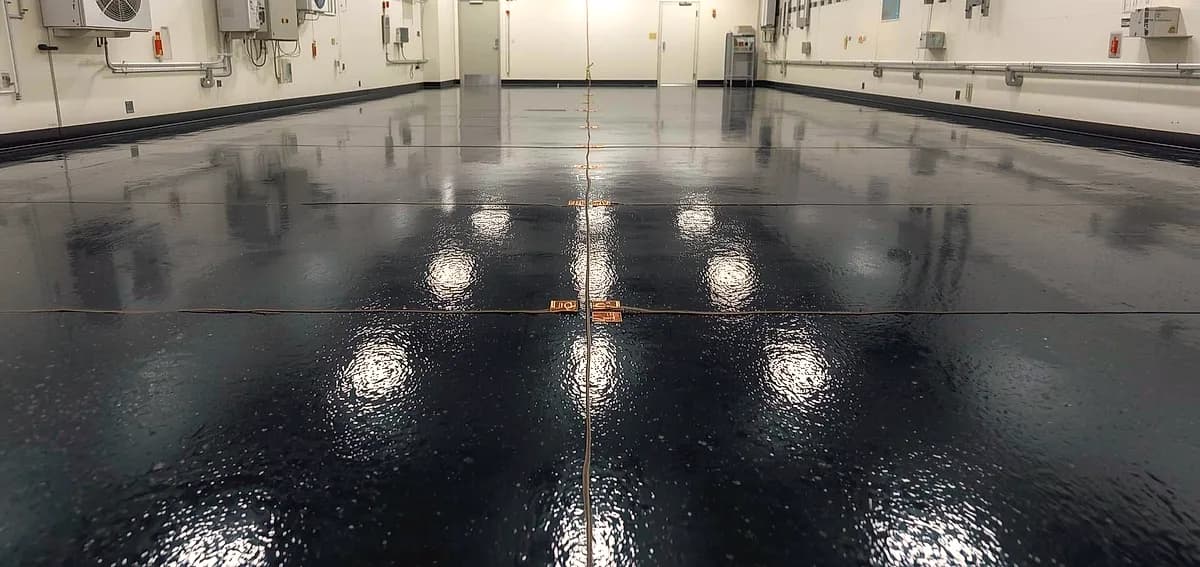
Copper grounding strips create the electrical pathway connecting ESD flooring to the building’s ground system. These strips, typically 1/2 inch to 2 inches wide, are installed beneath the epoxy coating and extend to verified ground points.
Standard practice requires one copper strip for every 1,000 square feet, with each room having at least one ground connection. Installation occurs after the primer coat dries but before topcoat application. Professional installers verify continuity with a volt-ohm meter before completing the system.
Ground Connection Methods
Three methods provide acceptable paths to ground. AC electrical outlets using the equipment grounding conductor represent the most common approach. Earth ground connections suit facilities built on or below grade, using a copper grounding rod driven into the soil. Building steel connections work when facilities have exposed structural columns with bare metal surfaces.
All grounding methods must comply with local electrical codes and OSHA requirements for equipment grounding.
Epoxy Floor System Installation
Surface Preparation
Proper concrete preparation determines installation success. Concrete grinding or shot blasting creates the necessary surface profile. Moisture testing proves essential in Florida’s humid climate, as concrete slabs can harbor vapor that causes coating failure. The moisture mitigation process may require vapor barrier primers before ESD coating application.
Coating System Layers
A complete ESD epoxy system includes multiple layers. The primer seals concrete and provides adhesion. The conductive body coat establishes electrical properties through carbon powder or other conductive additives—proper thickness measurement is critical. The topcoat provides wear resistance while maintaining static control function and covering the copper grounding strips.
Testing and Verification
Initial Qualification Testing
Qualification testing confirms electrical performance after the topcoat fully cures. Surface resistance testing per ANSI/ESD STM7.1 uses electrodes at multiple locations to verify readings fall within acceptable ranges. Both point-to-point and point-to-ground measurements confirm system integrity.
The substrate testing process should document baseline values for future comparison, including environmental conditions at the time of testing.
Ongoing Compliance Verification
ESD flooring requires regular testing to verify continued performance. Industry best practices recommend quarterly resistance testing with documentation. Facilities certified to ANSI/ESD S20.20 must maintain records for audits. Personnel training ensures everyone understands proper cleaning procedures, footwear requirements, and damage reporting protocols.
South Florida Climate Considerations
Fort Lauderdale’s subtropical climate creates unique challenges. High humidity can benefit static control by increasing surface moisture that dissipates charges. However, low humidity during winter or in heavily air-conditioned spaces increases static generation.
The combination of salt air and humidity near the coast accelerates degradation. Coastal facilities should select coating systems designed for harsh environments. Coating application requires specific temperature and humidity ranges—most ESD epoxy systems need temperatures between 50°F and 90°F with humidity below 85%.
Maintenance Best Practices
ESD flooring requires specific cleaning methods that maintain electrical properties. Harsh chemicals can degrade conductive additives. Wax and floor finish products are generally prohibited as they create insulative layers. Dust mopping followed by damp mopping with approved cleaners represents the standard approach.
Damaged areas require prompt repair to maintain ESD protection. Gouges and wear patterns create discontinuities that can leave floor portions ungrounded. Testing after repair confirms acceptable resistance values.
Frequently Asked Questions
What resistance range do electronics facilities need for ESD flooring?
Most facilities require flooring below 1.0 x 10⁹ ohms per ANSI/ESD S20.20. The ideal range typically falls between 10⁵ and 10⁸ ohms.
How often should ESD flooring be tested?
Quarterly resistance testing with documentation is recommended. Certified facilities must maintain records for audit purposes.
How many grounding connections does an ESD floor need?
One copper grounding strip per 1,000 square feet of contiguous flooring. Each isolated room requires its own connection.
What causes ESD flooring to fail?
Common causes include improper preparation, moisture issues, incompatible cleaning chemicals, physical damage, and inadequate grounding.
Do personnel need special footwear on ESD floors?
ANSI/ESD S20.20 requires the combined person-footwear-flooring system to meet resistance specifications. Most facilities require ESD-rated footwear.
How long does ESD epoxy flooring last?
Properly installed systems typically provide 10 to 15 years of service with regular maintenance and testing.
What is the difference between conductive and dissipative flooring?
Conductive flooring measures below 1.0 x 10⁶ ohms with faster charge dissipation. Static dissipative measures between 1.0 x 10⁶ and 1.0 x 10⁹ ohms.
Does humidity affect ESD floor performance?
Yes, higher humidity reduces static generation while low humidity increases it. Testing should occur at the lowest expected humidity levels.
What certifications should an ESD flooring contractor have?
Contractors should demonstrate knowledge of ANSI/ESD S20.20 requirements and experience with electronics facility projects.
Can existing floors be converted to ESD flooring?
Existing coatings can sometimes serve as a base, but proper testing and surface preparation are essential for compatibility.
Sources
- ANSI/ESD S20.20-2021 Standard Overview – American National Standards Institute
- OSHA Electrical Grounding Requirements – Occupational Safety and Health Administration
Get Expert ESD Flooring Installation
Electronics facilities throughout Fort Lauderdale trust National Concrete Polishing for professional ESD epoxy flooring installations. Our team understands technical requirements for protecting sensitive equipment and delivers systems meeting ANSI/ESD S20.20 specifications.
Contact us today for a consultation on your electronics facility flooring project.
Written by

Founder and CEO
Chris Lavin is an esteemed leader in concrete polishing and epoxy coatings with a distinguished 20-year career. As founder and CEO of National Concrete Polishing and owner of Xtreme Polishing Systems, he's renowned for polishing and epoxy coating more floors than anyone globally. Chris is recognized for his innovative approach and commitment to enhancing floor durability and aesthetics. His hands-on experience and technical proficiency make him a respected authority and a valuable resource in the field of floor polishing and coatings.
Same topic
Related articles
All stories
Commercial9 min read
How Polished Concrete Solves Office Acoustic Problems
Hard floors and noise complaints. What polished concrete does to sound in an open office, and how to spec around it.
Read it
Commercial10 min read
Flooring for Hotel Wet Areas, Kitchens, and Parking Decks
Kitchens, pool decks and parking structures punish a floor daily. Which systems hold up in hotel service areas, and why.
Read it
Commercial11 min read
Specifying Floors for a New Hotel Build
For owners and architects on a new build. What to write into the flooring spec so the hotel opens on a floor that lasts.
Read it
Tell us about the floor
Tell us the space and roughly how big it is.We come back with what it would cost and when we could start.
Prefer to talk? Call +1 844-876-5474
- Leads@
nationalconcretepolishing.net - 2200 NW 32nd St #600,
Pompano Beach, FL 33069 Mon to Fri, 9:00 to 5:30