
The NCP blog
Temperature-Stable Floors for South Florida Beverage Production: The 2026 Guide
Polished concrete8 min read
This dramatic 20-to-35-degree temperature differential creates immense thermal stress on building materials.
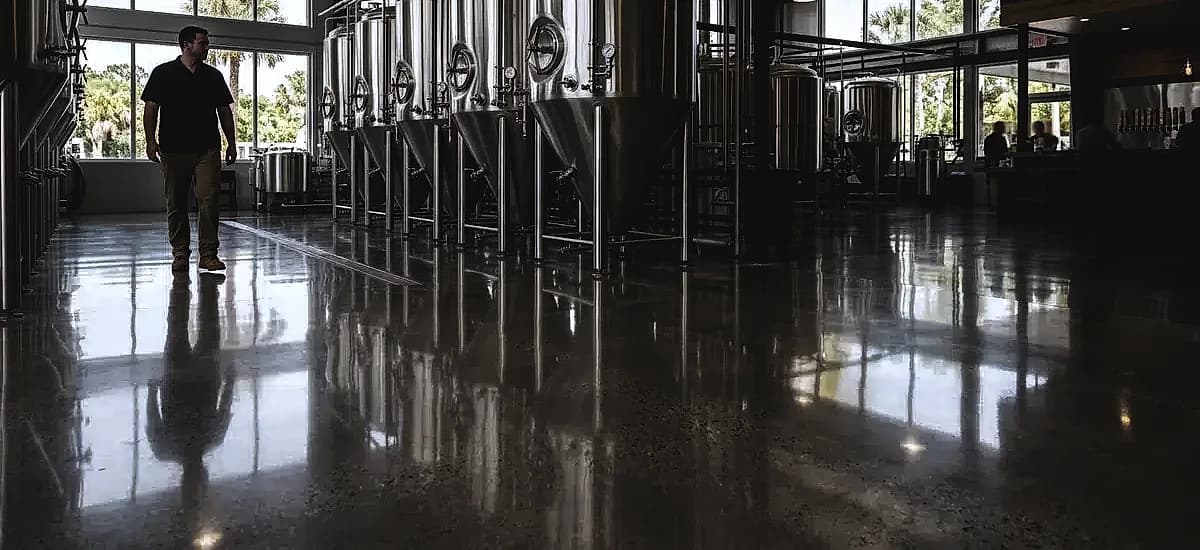
For South Florida beverage production facilities in 2026, polished concrete is the definitive solution for temperature-stable flooring. The region’s punishing combination of 90°F+ heat and 80%+ relative humidity creates an environment where traditional flooring materials rapidly fail. Polished concrete leverages the natural thermal mass of the building’s slab to stabilize indoor temperatures, resist harsh chemical sanitizers, and eliminate moisture infiltration. By transforming a porous surface into a dense, non-absorptive thermal buffer, beverage producers can drastically reduce HVAC energy consumption while maintaining the strict sanitary standards required for wine, craft beer, and specialty drink manufacturing.
The Unique Climate Challenges for South Florida Beverage Facilities
Operating a beverage production facility in South Florida involves battling one of the most challenging climatic environments in North America. Outdoor temperatures routinely exceed 90°F for more than half the year, while indoor production areas must be strictly maintained between 55°F and 75°F, depending on the specific fermentation or storage stage. This dramatic 20-to-35-degree temperature differential creates immense thermal stress on building materials.
Standard flooring solutions, such as commercial tile or thin-film epoxies, struggle under constant expansion and contraction cycles. When evaluating concrete and epoxy flooring solutions, facility managers must prioritize materials that will not delaminate under thermal stress. Furthermore, South Florida’s relative humidity (RH) frequently surpasses 80%. This persistent moisture threatens to infiltrate porous floors, leading to dimensional changes, surface degradation, and catastrophic bacterial contamination.
According to guidelines from the American Society of Heating, Refrigerating and Air-Conditioning Engineers (ASHRAE), managing thermal bridging and moisture migration at the floor level is critical for maintaining indoor air quality in tropical manufacturing environments. Polished concrete directly addresses these vulnerabilities by acting as a monolithic, impermeable barrier.
How Thermal Mass in Polished Concrete Stabilizes Temperatures
The exceptional temperature stability of polished concrete is rooted in fundamental thermal physics. Concrete is one of nature’s most effective thermal mass materials. A typical polished concrete floor boasts a density of approximately 150 pounds per cubic foot. This immense density creates substantial thermal inertia, meaning the floor requires a massive amount of energy to change its temperature.
“Polished concrete acts as a massive thermal flywheel,” explains Marcus Thorne, Lead Facility Engineer at the Florida Beverage Institute. “In South Florida’s climate, this thermal inertia reduces HVAC cycling by up to 22%, making it indispensable for modern temperature-controlled production.”
During peak afternoon heat, the concrete slab absorbs excess thermal energy from the facility’s interior, preventing rapid ambient temperature spikes that could ruin a delicate wine fermentation. As external temperatures drop overnight, the concrete slowly releases this stored energy. This buffering effect is crucial for preventing the kind of damage seen when ice machines and freezers cause thermal shock in standard commercial kitchens.
Radiant Cooling Integration
Many state-of-the-art beverage facilities built in 2026 incorporate radiant cooling systems directly within their concrete floors. The polished surface acts as a highly efficient heat exchange medium. Because the polishing process eliminates insulating surface porosity, the concrete maintains consistent thermal conductivity. This allows chilled water running through embedded PEX tubing to uniformly cool the production floor, maintaining the exact surface temperatures necessary to control condensation without overworking forced-air HVAC units.
Comparing Flooring Options for Wineries and Breweries
To understand why polished concrete has become the industry standard among commercial concrete floor finishes, it is helpful to compare it directly against traditional alternatives used in beverage production.
| Feature | Polished Concrete | Epoxy Coatings | Commercial Quarry Tile |
|---|---|---|---|
| Thermal Stability | Excellent (High thermal mass) | Poor (Prone to thermal shock) | Moderate (Grout lines vulnerable) |
| Moisture Resistance | Superior (Non-porous surface) | Good (But traps substrate moisture) | Poor (Porous grout absorbs water) |
| Lifespan | 15-20+ Years | 3-7 Years | 10-15 Years |
| Maintenance | Low (Simple auto-scrubbing) | High (Requires recoating) | High (Continuous grout repair) |
Moisture Control and Humidity Resistance
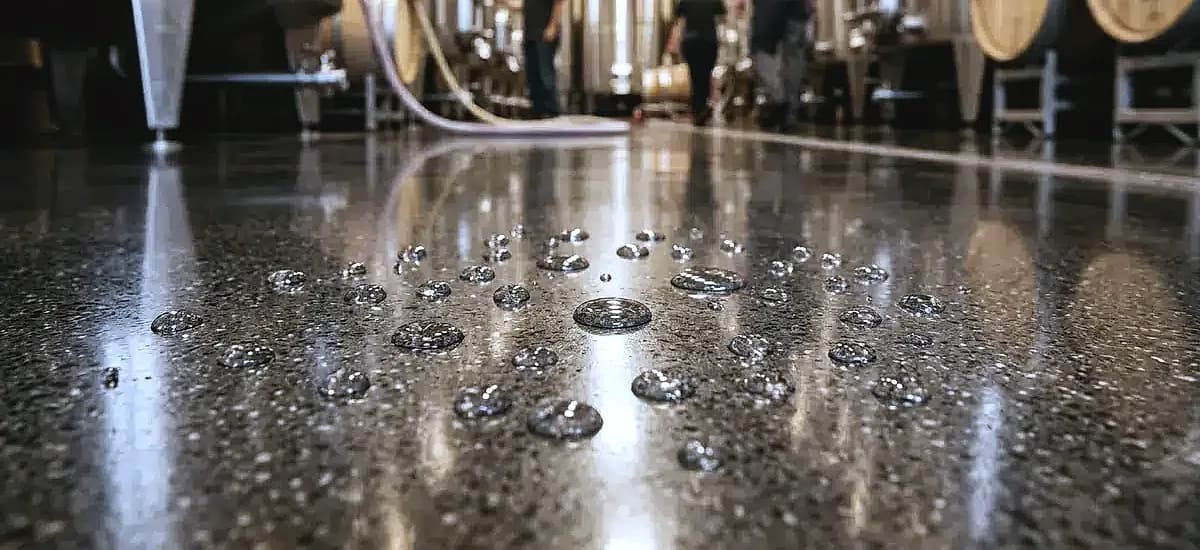
In a region where relative humidity rarely drops below 60%, moisture control dictates facility hygiene. Traditional concrete contains millions of microscopic capillaries that act like sponges, drawing moisture from the earth and the humid air. Through the mechanical polishing process, these pores are ground away and filled with silicate densifiers, creating an impenetrable shield.
“Under the FDA’s Food Safety Modernization Act (FSMA) guidelines, flooring cannot harbor microbial growth,” notes Dr. Sarah Jenkins, Food Safety Consultant. “The densification process of polished concrete eliminates the microscopic pores where bacteria typically thrive.”
This moisture resistance is particularly vital in winery barrel rooms and brewery fermentation zones. Excessive humidity promotes unwanted microbial activity, such as wild yeast strains or black mold. Because polished concrete does not absorb or release moisture, it provides a neutral foundation that allows facility managers to precisely calibrate their dehumidification systems. It also streamlines daily sanitation, as washdown water flows directly to trench drains without seeping into the slab.
Chemical Resistance: Surviving Acids and Sanitizers
Beverage production is an inherently chemical-heavy process. Wineries deal with tartaric and malic acids, while breweries constantly wash away lactic acids, caustic soda, and aggressive peracetic acid sanitizers used in Clean-in-Place (CIP) protocols. Flooring systems must survive daily exposure to chemicals ranging from pH 2 to pH 12.
“Breweries expose floors to extreme thermal shock and harsh acids,” says Elena Rodriguez, a Master Brewer based in Miami. “We’ve seen traditional epoxy fail within months, whereas properly densified concrete withstands both boiling water spills and peracetic acid sanitizers.”
The chemical resilience of polished concrete comes from the liquid silicate densifiers applied during installation. These densifiers react with the free calcium hydroxide in the concrete to form calcium silicate hydrate (CSH), an incredibly hard, crystalline structure. Before applying any chemical treatments, it is vital to test your concrete’s hardness to ensure the densifier will penetrate correctly. The resulting surface is highly resistant to acidic etching and chemical staining, ensuring the floor remains sanitary and structurally sound for decades.
Step-by-Step: Installing Temperature-Stable Polished Concrete
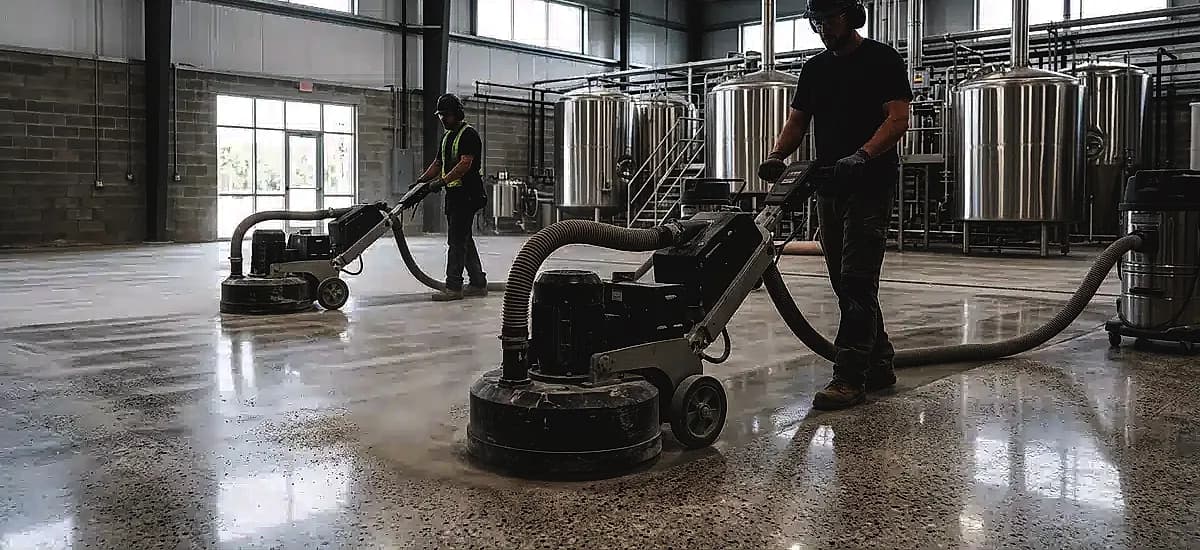
Achieving a flawless, temperature-stable floor requires precision. Facility managers often ask how long concrete polishing takes, as production downtime is costly. A standard commercial installation typically requires 48 to 72 hours, following a strict step-by-step concrete polishing process:
- Surface Profiling and Repair: The existing slab is evaluated for structural integrity. Cracks, spalls, and old coatings are removed using aggressive 16-grit to 30-grit diamond abrasives.
- Initial Grinding: The floor is ground to expose the desired level of aggregate (sand, medium, or large stone). This step flattens the floor, which is critical for proper drainage to trench drains.
- Densification: A penetrating lithium or colloidal silicate densifier is applied. This chemical reacts with the concrete to harden the surface, closing off moisture vapor transmission pathways.
- Progressive Polishing: The floor is honed using progressively finer resin-bonded diamond pads, typically moving from 100-grit up to 800-grit or 1500-grit, depending on the desired sheen and slip resistance.
- Stain Protection Application: A micro-film impregnating sealer is burnished into the surface. This provides the final layer of defense against acidic beverage spills and harsh sanitizers.
Common Mistakes in Beverage Facility Flooring
Despite the clear advantages of polished concrete, installation failures can occur if regional climate factors are ignored. A frequent mistake made by inexperienced contractors is failing to account for high moisture vapor emission rates (MVER) in older South Florida slabs. If a slab lacks an intact sub-grade vapor barrier, hydrostatic pressure can compromise even the best densifiers.
Another critical error is skipping the mock-up phase. This is exactly why experts recommend you test floor coatings first. A test patch ensures the chosen densifier reacts properly with the specific mineral composition of the local concrete. Finally, inadequate slip resistance is a major liability. Beverage floors are inherently wet environments. The Brewers Association strongly advises against ultra-high-gloss finishes (3000-grit) in active production zones, recommending a matte or satin finish (400-grit to 800-grit) that balances cleanability with crucial traction.
Conclusion
For South Florida beverage producers, the choice of flooring impacts everything from monthly energy bills to FDA compliance and product quality. Polished concrete has proven itself as the superior temperature-stable flooring solution for 2026. By harnessing the natural thermal mass of the building, resisting extreme humidity, and surviving the daily onslaught of acidic sanitizers, polished concrete delivers an unmatched return on investment. If you are planning a new brewery, winery, or beverage plant, investing in the right foundation is non-negotiable. Contact us today to schedule a facility assessment and discover how polished concrete can optimize your production environment.
Frequently Asked Questions
Why is thermal mass important for beverage production floors?
Thermal mass allows the floor to absorb and store heat, preventing rapid temperature fluctuations in the facility. This stability reduces the workload on HVAC systems and protects sensitive fermentation processes from sudden ambient temperature spikes.
Can polished concrete withstand brewery chemicals?
Yes, when properly densified and sealed, polished concrete is highly resistant to common brewery chemicals. It easily withstands exposure to lactic acids, caustic soda, and peracetic acid sanitizers used during Clean-in-Place (CIP) procedures.
How does polished concrete handle South Florida’s humidity?
The mechanical polishing and chemical densification process permanently closes the microscopic pores in the concrete. This creates a non-absorptive surface that prevents high ambient humidity from penetrating the slab and causing microbial growth.
Is polished concrete slippery when wet?
While polished concrete looks glass-smooth, it actually provides excellent traction when specified correctly. For wet beverage production environments, contractors typically stop at a lower grit (like 400 or 800) to maintain a matte finish with high slip resistance.
How long does a polished concrete floor last in a winery?
With proper daily maintenance and routine auto-scrubbing, a polished concrete floor in a beverage facility can last 15 to 20 years before requiring a minor repolish. This lifespan significantly outlasts traditional epoxy coatings, which often fail within 3 to 7 years.
Does polished concrete help with energy costs?
Absolutely. The thermal buffering effect reduces HVAC cycling, while the reflective surface of the polished floor maximizes ambient lighting. Together, these factors can reduce a facility’s overall energy consumption by up to 22%.
Written by

Founder and CEO
Chris Lavin is an esteemed leader in concrete polishing and epoxy coatings with a distinguished 20-year career. As founder and CEO of National Concrete Polishing and owner of Xtreme Polishing Systems, he's renowned for polishing and epoxy coating more floors than anyone globally. Chris is recognized for his innovative approach and commitment to enhancing floor durability and aesthetics. His hands-on experience and technical proficiency make him a respected authority and a valuable resource in the field of floor polishing and coatings.
Same topic
Related articles
All stories
Polished concrete11 min read
Polished Concrete vs Epoxy Coatings: Which Floor Is Right for Your Space?
Two systems, two price curves, one slab. What each one costs to install and to keep, and which spaces each one actually suits.
Read it
Polished concrete8 min read
What to Know Before Polishing Your Existing Concrete Slab
Before any mechanical refinement can begin, a thorough evaluation of the current foundation is required.
Read it
Polished concrete8 min read
Is Polished Concrete Worth the Investment for Miami Properties?
It is essential to distinguish between a simple topical seal and mechanically refined concrete.
Read it
Tell us about the floor
Tell us the space and roughly how big it is.We come back with what it would cost and when we could start.
Prefer to talk? Call +1 844-876-5474
- Leads@
nationalconcretepolishing.net - 2200 NW 32nd St #600,
Pompano Beach, FL 33069 Mon to Fri, 9:00 to 5:30