
The NCP blog
The 2026 Guide to Quiet, Dust-Free Polished Concrete for South Florida Libraries
Polished concrete9 min read
Historically, facility managers relied on broadloom carpet for sound absorption or VCT for durability.
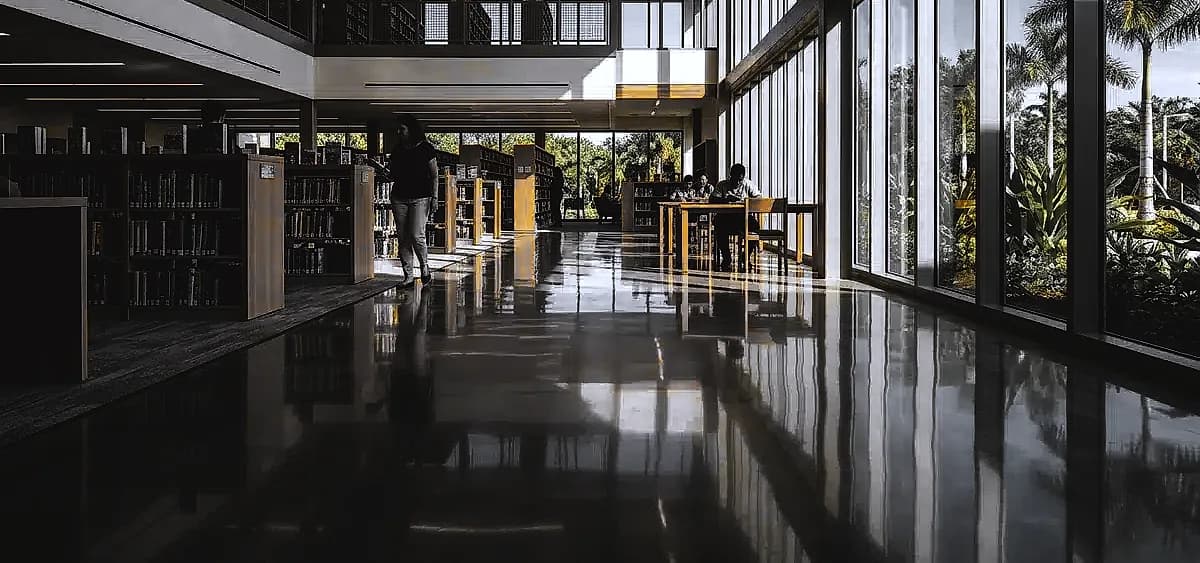
Polished concrete is the premier flooring solution for South Florida public libraries in 2026 because it mechanically eliminates dust generation, significantly dampens foot traffic noise, and provides a highly reflective surface that reduces energy costs. Unlike commercial carpeting that harbors allergens or vinyl tile that amplifies ambient sound, a mechanically polished and densified concrete slab creates an inert, hypoallergenic, and acoustically balanced environment. This transformation is essential for modern archival preservation, digital server protection, and maintaining the tranquil atmosphere required in community study spaces.
The Evolution of Library Architecture in South Florida
Public libraries have evolved far beyond simple book repositories; in 2026, they serve as dynamic multimedia hubs, community centers, and digital archives. This functional shift demands building materials that can withstand heavy foot traffic while supporting a pristine indoor environment. Historically, facility managers relied on broadloom carpet for sound absorption or VCT for durability. However, in South Florida’s uniquely humid climate, these traditional materials present severe operational challenges.
According to the American Library Association (ALA), over 45% of library renovations in the current decade prioritize indoor air quality and sustainable material lifecycles. Carpeting acts as a sponge for moisture and allergens, while tile requires harsh chemical strippers and waxes that degrade indoor air quality. Polished concrete has emerged as the definitive solution, bridging the gap between industrial durability and architectural elegance.
“In South Florida’s humid climate, eliminating porous flooring materials is the single most effective strategy for preserving rare manuscripts and maintaining healthy indoor air quality,” notes Sarah Jenkins, Lead Archivist at the Heritage Preservation Society.
Acoustic Engineering: Creating a Silent Study Environment
Sound management represents one of the most critical aspects of library design. When patrons walk across a floor, the impact generates sound waves that can either be absorbed by the substrate or reflected into the room. Traditional tile flooring creates a hollow, echoing effect—often referred to as the “drum effect”—because footsteps resonate through the material and into the microscopic air voids in the adhesive layer below.
Polished concrete fundamentally alters this dynamic. Because the surface is monolithic and directly integrated with the building’s foundation, it boasts an exceptionally high Impact Insulation Class (IIC) rating. There are no hollow spaces to amplify sound. Furthermore, modern polishing techniques smooth the microscopic peaks and valleys of the slab, reducing the friction that causes shoe squeaking.
“Polished concrete fundamentally changes the acoustic dynamics of a library space, absorbing impact noise that traditional tile amplifies,” says Dr. Aris Thorne, Acoustic Engineer at the Building Sciences Institute. Research from the National Institute of Building Sciences indicates that properly densified monolithic slabs can reduce reverberation times by up to 1.2 seconds in large open-plan facilities. For facility managers dealing with multi-story buildings, understanding sound transmission through concrete floors is vital for keeping lower-level reading rooms completely silent.
Dust-Free Environments for Archival and Digital Preservation
The preservation of physical books, historical documents, and modern electronic equipment is the fundamental responsibility of any library. Unsealed or poorly coated concrete naturally undergoes a process called “efflorescence” or “dusting.” As moisture moves through the porous slab, it carries free calcium hydroxide to the surface, which dries into a fine, abrasive white powder. This dust settles on book spines, infiltrates HVAC systems, and can cause catastrophic overheating in computer servers.
The concrete polishing process completely halts this chemical reaction. During installation, technicians apply a liquid lithium silicate densifier. This chemical penetrates deep into the concrete’s capillary pores and reacts with the free calcium hydroxide to form calcium silicate hydrate (CSH)—a dense, insoluble crystalline structure. This process fills the microscopic voids, creating a solid, dust-proof mass.
“The mechanical densification process creates a surface so tight that microscopic dust particles simply cannot escape, protecting both patrons and sensitive server equipment,” explains Marcus Chen, Director of Commercial Flooring Technologies. The Environmental Protection Agency (EPA) highlights that eliminating source pollutants—such as concrete dust and carpet VOCs—is the most effective method for improving indoor air quality. Before beginning this process, facility managers often ask, do you need to seal concrete before polishing? The answer lies in the mechanical densification step, which acts as a permanent internal seal.
Comparative Analysis: Polished Concrete vs. Traditional Library Flooring
To fully grasp the operational advantages of polished concrete, it is helpful to compare it directly against the two most common legacy flooring options found in civic buildings: Commercial Broadloom Carpet and Vinyl Composition Tile (VCT).
| Feature | Polished Concrete | Commercial Carpet | Vinyl Composition Tile (VCT) |
|---|---|---|---|
| Acoustic Control | Excellent (No hollow resonance) | Excellent (High absorption) | Poor (Amplifies footfall) |
| Dust & Allergen Control | Superior (100% inert surface) | Poor (Traps dust/mold) | Moderate (Requires chemical wax) |
| Lifespan | 30+ Years | 5-7 Years | 10-15 Years |
| Annual Maintenance Cost | $0.25 – $0.50 / sq. ft. | $1.00 – $1.50 / sq. ft. | $1.50 – $2.50 / sq. ft. |
The Step-by-Step Installation Process for Active Libraries
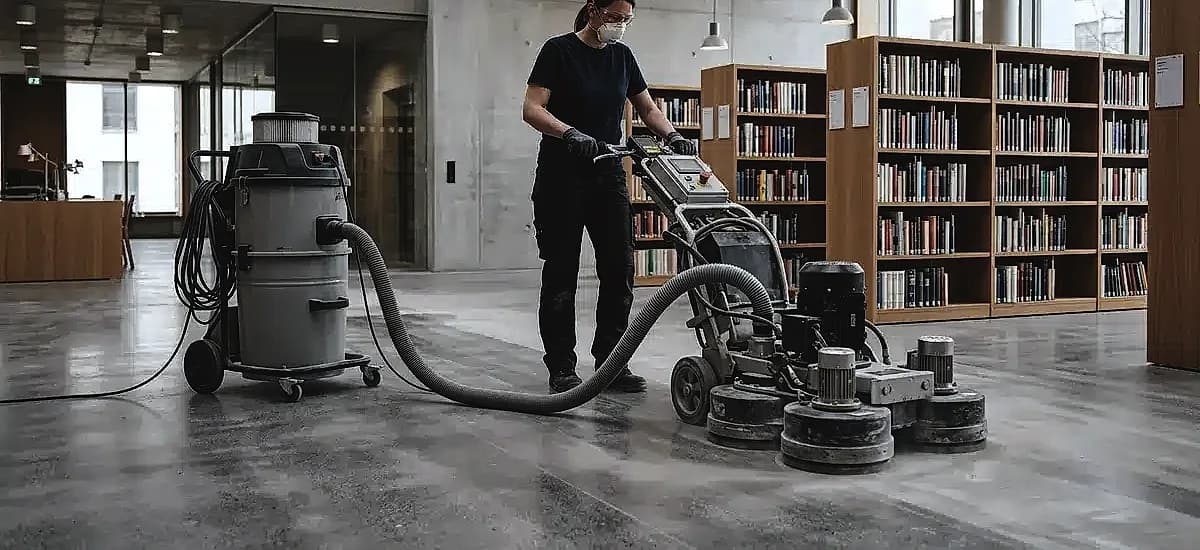
Installing polished concrete in an active civic environment requires meticulous planning to minimize disruption. Professional contractors utilize advanced HEPA-filtered equipment to ensure zero airborne dust during the renovation. The process follows a strict, scientifically calibrated sequence.
- Substrate Evaluation and Scanning: Before any grinding begins, technicians assess the slab’s moisture vapor transmission rate (MVTR) and structural integrity. In older South Florida buildings, GPR scanning for concrete is often utilized to locate post-tension cables or hidden plumbing lines beneath the surface.
- Surface Preparation: Heavy-duty planetary grinders equipped with coarse metal-bonded diamond tooling (typically 16 to 30 grit) remove existing coatings, glues, and surface imperfections. This step opens the concrete pores.
- Chemical Densification: Once the slab is clean and pores are open, a lithium or colloidal silica densifier is applied. This hardens the surface, increasing its abrasion resistance by up to 400% and permanently stopping concrete dusting.
- Progressive Polishing: The floor is honed using progressively finer resin-bonded diamond pads. Understanding the polishing stages in Fort Lauderdale is crucial; technicians typically move from 100-grit up to 800 or 1500-grit, depending on the desired sheen.
- Final Sealing and Burnishing: A micro-film stain guard is applied and burnished into the floor using a high-speed machine. This provides immediate resistance against spills from coffee or water, ensuring the floor remains pristine.
Maximizing Natural Light and Energy Efficiency
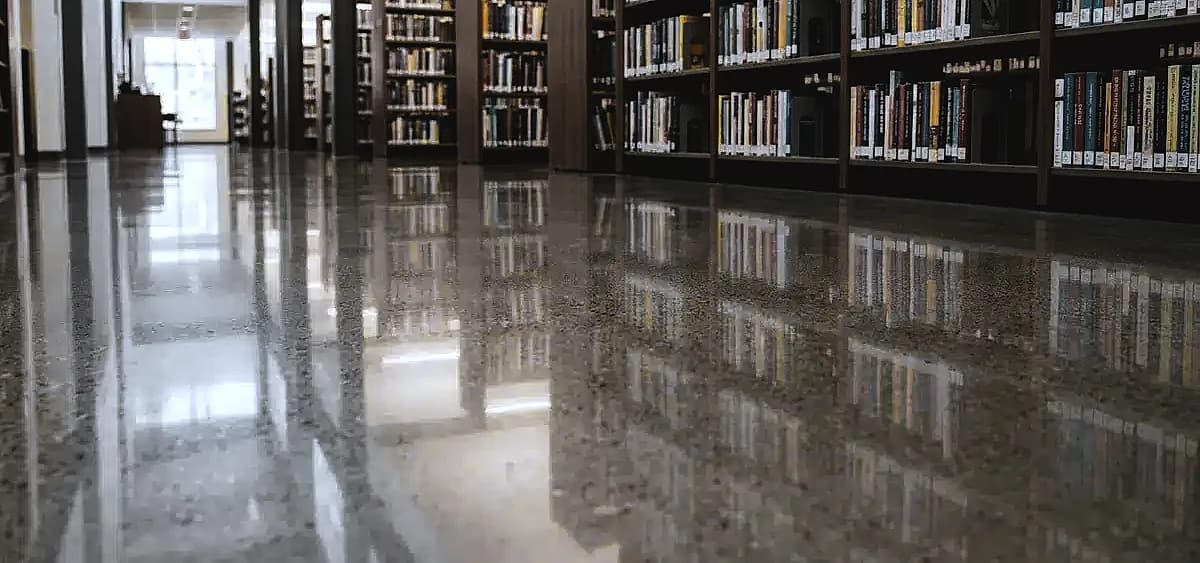
Modern library design heavily emphasizes sustainability and energy conservation. Polished concrete contributes significantly to these goals through its Light Reflectance Value (LRV). A highly polished concrete floor can achieve an LRV of up to 85%, meaning it reflects 85% of the light that hits it back into the room.
According to the U.S. Department of Energy, optimizing interior surface reflectance can reduce a commercial building’s lighting energy consumption by 30% to 40%. By bouncing natural sunlight from large library windows deeper into the stacks, facilities can keep artificial lights dimmed or turned off during peak daylight hours.
“By maximizing natural light through high-gloss concrete finishes, public facilities are cutting their artificial lighting dependency by nearly a third,” states Elena Rodriguez, a LEED Certified Architect specializing in civic buildings. Furthermore, the thermal mass of the concrete helps regulate indoor temperatures. Facility directors are increasingly recognizing the thermal benefits keeping buildings cooler, which directly translates to lower HVAC operational costs in South Florida’s relentless summer heat.
Long-Term Maintenance Protocols for Public Facilities
The economic advantages of polished concrete library flooring extend far beyond the initial installation. The true value is realized in the decades of reduced maintenance expenses. Traditional VCT requires a grueling cycle of stripping toxic wax, neutralizing the floor, applying multiple coats of new finish, and high-speed buffing. This process is not only expensive but forces sections of the library to close due to strong chemical odors.
Polished concrete eliminates this cycle entirely. Daily maintenance requires only a microfiber dust mop to remove loose debris. For wet cleaning, an auto-scrubber equipped with non-abrasive pads and a pH-neutral cleaner is sufficient. There are no waxes to strip, no carpets to steam clean, and no grout lines to scrub. Facility managers report saving between $1.50 and $3.00 per square foot annually on maintenance labor and chemicals alone.
When considering concrete floor finishes in South Florida, the longevity of polished concrete is unmatched. With proper routine care, a polished concrete floor will easily outlast the 30-year lifecycle of the building’s interior fixtures, requiring only a minor repolish (a “refresh”) every 7 to 10 years depending on foot traffic.
Frequently Asked Questions
How long does polished concrete installation take in an active library?
Installation timelines vary based on the square footage and the condition of the existing slab. However, professional teams can typically complete 1,000 to 1,500 square feet per day. For a detailed breakdown of scheduling, facility managers should review how long concrete polishing takes to properly phase the project without closing the entire library.
Is polished concrete slippery when wet, especially near library entrances?
Despite its glass-like appearance, clean polished concrete meets or exceeds OSHA standards for slip resistance. The mechanical grinding process creates microscopic porosity that provides traction. For entrance vestibules prone to rainwater, anti-slip micro-aggregates can be burnished into the final sealer for added safety.
Can polished concrete be installed over existing VCT or carpet?
No, the existing flooring and all underlying adhesives must be completely removed to expose the bare concrete slab. Advanced ride-on scrapers and heavy-duty diamond grinders are used to remove mastics and glues before the actual polishing process can begin.
How does polished concrete perform in South Florida’s humid climate?
It performs exceptionally well. Because polished concrete is breathable, it allows ground moisture vapor to pass through without peeling or blistering—a common failure point for epoxy coatings or glued-down carpets in humid environments. It also provides zero organic material for mold or mildew to consume.
Will the concrete polishing process create dust that damages library books?
Professional concrete polishing is a virtually dust-free process. Industrial grinders are connected directly to massive HEPA-filtered vacuum systems that capture 99.9% of airborne particulates at the source, ensuring that books, computers, and HVAC systems remain completely uncontaminated during installation.
Does polished concrete emit any odors or VOCs?
Properly installed polished concrete is completely inert and emits zero Volatile Organic Compounds (VOCs). The densifiers and stain guards used in modern 2026 applications are water-based and environmentally friendly, making it the safest flooring choice for indoor air quality.
Can decorative elements or library logos be incorporated?
Yes. Before the final sealing stages, concrete dyes can be applied to create wayfinding paths, designate children’s reading areas, or embed the library’s official seal directly into the floor. These dyes penetrate the concrete pores, meaning they will never peel or chip away.
What is the expected lifespan of a polished concrete library floor?
When properly maintained with daily dust mopping and pH-neutral cleaning, a polished concrete floor can last the lifetime of the building (30+ years). It offers the lowest lifecycle cost of any commercial flooring material available today.
Conclusion
The selection of polished concrete for South Florida public libraries represents a strategic, long-term investment in community infrastructure. By addressing the unique challenges of the 2026 architectural landscape—specifically the need for superior acoustic control, absolute dust elimination, and climate resilience—polished concrete stands out as the definitive flooring solution. It protects invaluable archival materials from particulate damage, enhances the acoustic tranquility necessary for study, and drastically reduces annual maintenance budgets.
As libraries continue to serve as the vital, multimedia heart of our communities, ensuring the foundational environment is safe, clean, and sustainable has never been more important. If you are planning a library renovation or new construction project and want to explore how this technology can transform your space, contact us today to schedule a comprehensive site evaluation and substrate analysis.
Written by

Founder and CEO
Chris Lavin is an esteemed leader in concrete polishing and epoxy coatings with a distinguished 20-year career. As founder and CEO of National Concrete Polishing and owner of Xtreme Polishing Systems, he's renowned for polishing and epoxy coating more floors than anyone globally. Chris is recognized for his innovative approach and commitment to enhancing floor durability and aesthetics. His hands-on experience and technical proficiency make him a respected authority and a valuable resource in the field of floor polishing and coatings.
Same topic
Related articles
All stories
Polished concrete11 min read
Polished Concrete vs Epoxy Coatings: Which Floor Is Right for Your Space?
Two systems, two price curves, one slab. What each one costs to install and to keep, and which spaces each one actually suits.
Read it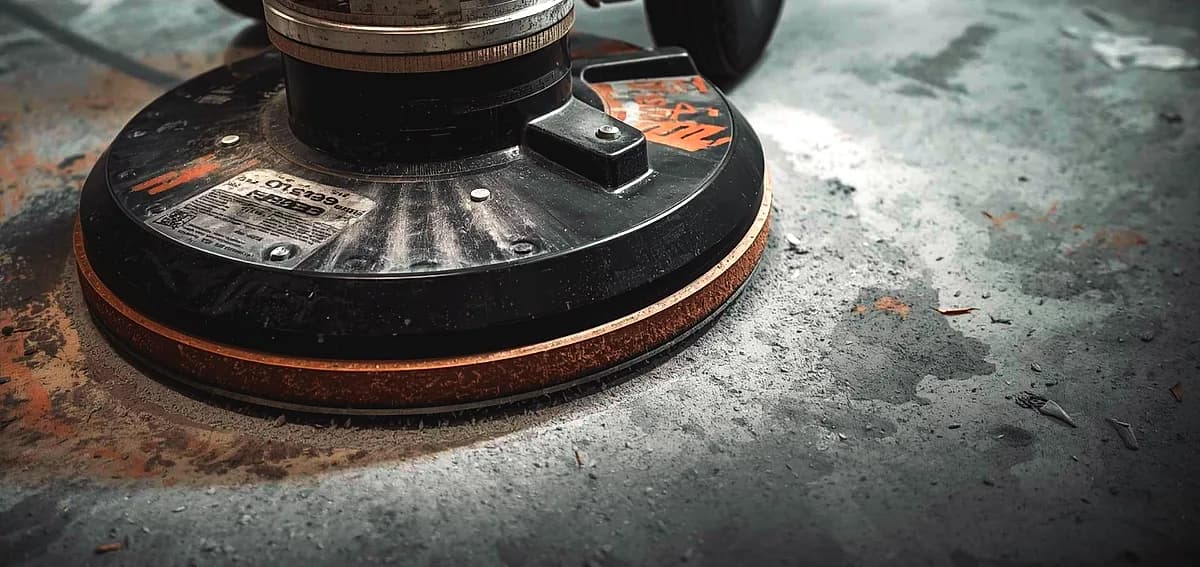
Polished concrete8 min read
What to Know Before Polishing Your Existing Concrete Slab
Before any mechanical refinement can begin, a thorough evaluation of the current foundation is required.
Read it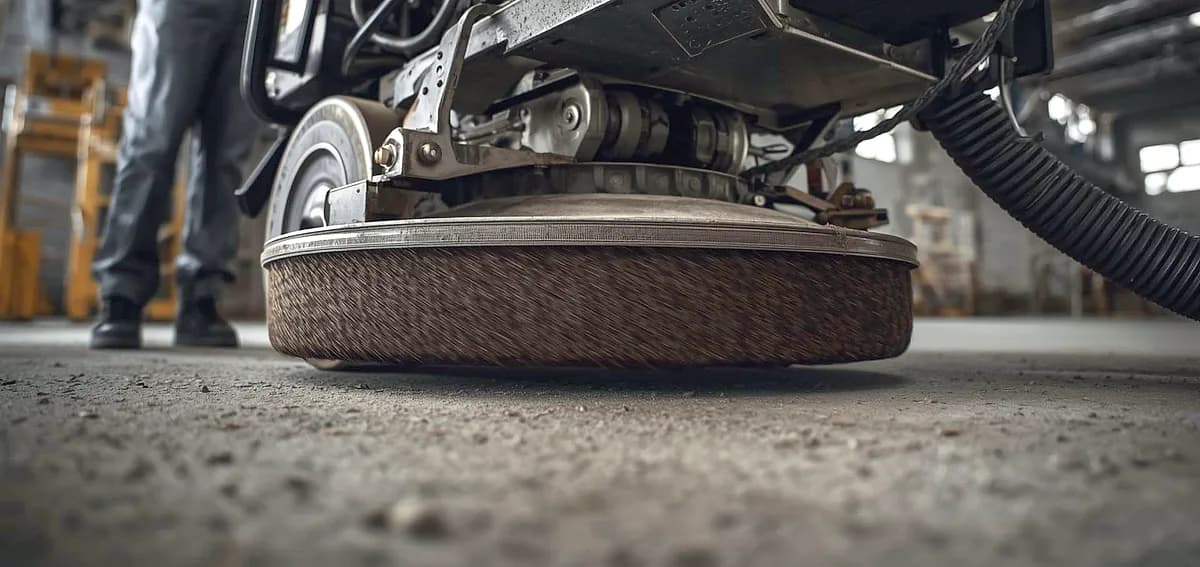
Polished concrete8 min read
Is Polished Concrete Worth the Investment for Miami Properties?
It is essential to distinguish between a simple topical seal and mechanically refined concrete.
Read it
Tell us about the floor
Tell us the space and roughly how big it is.We come back with what it would cost and when we could start.
Prefer to talk? Call +1 844-876-5474
- Leads@
nationalconcretepolishing.net - 2200 NW 32nd St #600,
Pompano Beach, FL 33069 Mon to Fri, 9:00 to 5:30