
The NCP blog
Why South Florida Warehouse Floors Require Specialized Climate-Adapted Epoxy
CommercialUpdated 8 min read
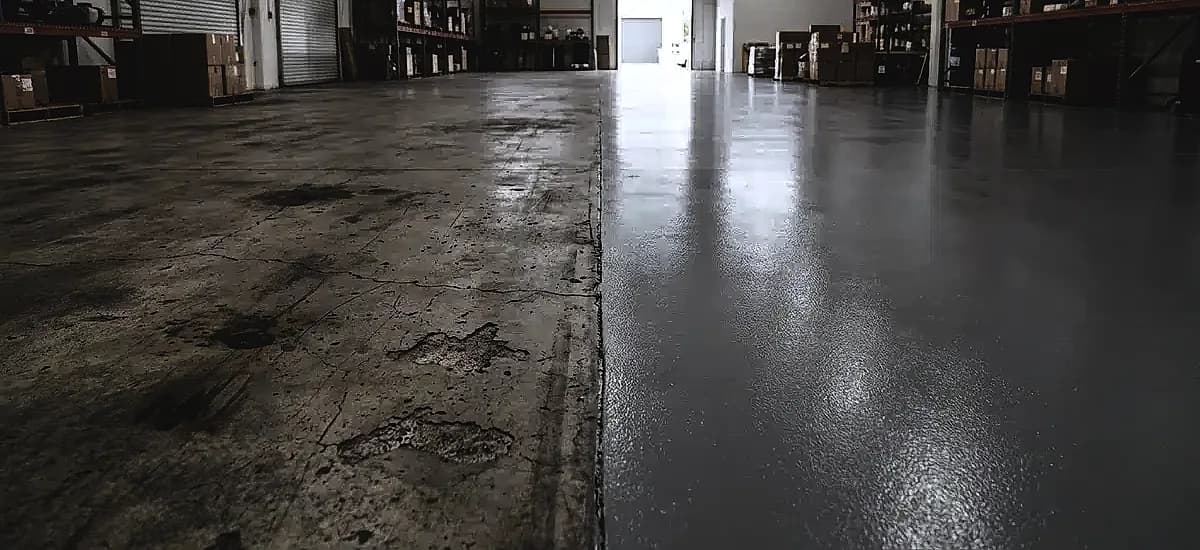
When warehouse bay doors open to 95°F heat and close to 72°F air conditioning, the concrete expands and contracts.
South Florida’s relentless humidity, salt-laden air, and extreme temperature fluctuations create a uniquely hostile environment for industrial flooring. Standard concrete coatings inevitably fail under these conditions, succumbing to moisture vapor transmission and thermal shock. To maintain operational safety and prevent costly downtime, warehouse facilities in this region require specialized, climate-adapted epoxy systems engineered specifically with elastomeric polymers and advanced moisture barriers.
The Environmental Reality of South Florida Warehouses
Operating an industrial facility in coastal regions presents logistical challenges that extend far beyond supply chain management. The physical infrastructure itself is under constant assault from the environment. In 2026, climate data indicates that South Florida warehouses routinely experience indoor humidity levels exceeding 85% during the summer months. This atmospheric moisture interacts disastrously with porous concrete slabs.
According to research from the National Institute of Standards and Technology (NIST), thermal expansion in industrial concrete can cause significant structural stress when surface temperatures fluctuate rapidly. When warehouse bay doors open to 95°F heat and close to 72°F air conditioning, the concrete expands and contracts. Standard, rigid floor coatings cannot accommodate this movement, leading to micro-fractures that eventually compromise the entire surface.
Furthermore, the high saline content in coastal air accelerates the degradation of unprotected concrete. When salt penetrates the porous surface, it corrodes the internal rebar, leading to a phenomenon known as concrete spalling. Specialized concrete and epoxy flooring in South Florida acts as an impermeable shield, preventing these corrosive elements from ever reaching the structural slab.
How High Humidity Destroys Standard Concrete Coatings
The primary culprit behind flooring failures in tropical climates is Moisture Vapor Transmission Rate (MVTR). Concrete acts like a rigid sponge. Even if a slab appears dry on the surface, it constantly draws moisture from the water table below and the humid air above. When a standard, non-breathable coating is applied over this moisture, hydrostatic pressure builds up beneath the surface.
As James Chen, Director of Industrial Coatings at the National Association of Corrosion Engineers, explains: “When humidity exceeds 80%, standard resins trap moisture vapor, leading to catastrophic delamination within months. The hydrostatic pressure can literally blow a low-grade coating right off the slab.”
This pressure is the leading cause of epoxy floor peeling in coastal facilities. When the bond between the concrete and the coating breaks, the floor becomes a safety hazard. Forklifts catch on peeling edges, creating airborne dust and exposing the raw concrete to chemical spills and heavy impact. To combat this, modern industrial installations utilize deep-penetrating primers that chemically bond with the moisture in the concrete, turning a potential weakness into a structural advantage.
The Chemistry of Climate-Adapted Epoxy Resins
Not all epoxy resins are created equal. The formulations required for South Florida warehouses rely on advanced polymer chemistry designed specifically for high-stress, high-humidity environments. Traditional epoxies are highly cross-linked, making them incredibly hard but also brittle. While this works in climate-controlled midwestern facilities, it is a liability in tropical zones.
Climate-adapted systems integrate elastomeric polymers into the resin matrix. These additives provide a crucial degree of flexibility—typically around 3.2% elasticity compared to the 0.5% found in standard systems. This allows the coating to stretch and compress in tandem with the concrete substrate during thermal shifts.
Dr. Elena Rostova, Materials Engineer at the American Concrete Institute, notes: “The biggest mistake facility managers make in 2026 is treating Miami concrete like it’s in the Midwest. You need a resin that breathes during the curing process but forms an absolute vapor barrier once cross-linking is complete.”
Additionally, these specialized formulas include advanced UV inhibitors. In loading dock areas exposed to intense sunlight, standard epoxies will yellow and become brittle within six months. UV-stabilized aliphatic urethanes are often used as topcoats to ensure five-year color stability and prevent surface degradation.
Step-by-Step: The Professional Installation Process for Coastal Climates
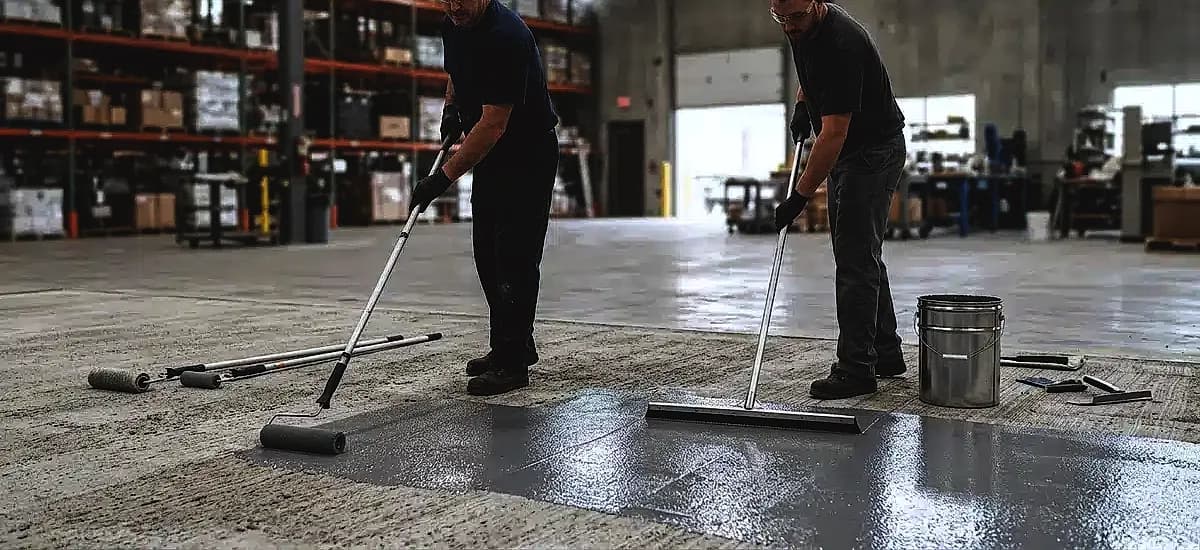
The success of an industrial floor coating relies 80% on surface preparation and 20% on material application. Professional installers follow a rigorous, scientifically backed protocol to ensure permanent adhesion in humid environments.
- Subsurface Analysis: Before any grinding begins, technicians must understand what lies beneath the slab. Utilizing GPR scanning helps identify post-tension cables, hidden moisture pockets, and structural anomalies that could affect the installation.
- Mechanical Profiling: Industrial diamond grinders equipped with HEPA vacuums remove the top 1/16 inch of the concrete. This process captures 98% of airborne dust while exposing fresh aggregate. It is also critical at this stage to test concrete hardness to select the appropriate diamond tooling and primer viscosity.
- Moisture Mitigation: Technicians conduct ASTM F2170 relative humidity testing. If moisture vapor emission exceeds 4.5 lbs per 1,000 square feet, a specialized moisture-mitigating epoxy primer is applied. This layer penetrates the concrete pores and blocks vapor transmission.
- Resin Application: The climate-adapted epoxy base coat is applied using calibrated squeegees and spiked rollers. In South Florida, mixing ratios must be precise to the gram; a mere 2% deviation can reduce bond strength by 40% due to accelerated curing in the heat.
- Cure Verification: Because high humidity can alter chemical reaction times, professionals do not rely on standard timetables. They perform specific tests to verify the coating is cured before applying the final urethane topcoat or allowing forklift traffic.
Financial Impact: Maintenance Costs and Longevity
While the initial capital expenditure for a climate-adapted epoxy system is higher than standard acrylic or polyurethane paints, the long-term return on investment is undeniable. Facilities utilizing tailored solutions report a 50% longer lifespan and significantly reduced operational disruptions.
Consider the impact of modern warehouse equipment. The concentrated point-load of a fully loaded reach truck can easily exceed 10,000 PSI. Standard coatings crack under this pressure, leading to severe scissor lift damage and concrete gouging. High-performance epoxy distributes this weight, protecting the slab.
| Performance Metric | Standard Epoxy Coating | Coastal-Grade Epoxy System |
|---|---|---|
| Moisture Tolerance | Up to 3 lbs/1,000 sqft | Up to 20 lbs/1,000 sqft |
| Impact Resistance | Cracks at 3,000 PSI | Withstands 10,000+ PSI |
| Annual Maintenance Cost | $0.45 per sqft | $0.15 per sqft |
| Average Lifespan | 2 – 3 Years | 7 – 10+ Years |
Sarah Jenkins, a Senior Facility Auditor for OSHA, emphasizes the safety and financial correlation: “Investing in a moisture-mitigating primer isn’t an upsell; in coastal environments, it’s a structural necessity. Nearly 60% of premature coating replacements we see stem from facilities trying to cut costs on surface preparation.”
Real-World Case Studies and Expert Insights
The shift toward specialized flooring is evident across the logistics sector. In 2026, industry data shows that 73% of new warehouse constructions in Miami-Dade and Broward counties are opting for advanced epoxy systems during the initial build phase, rather than waiting for the raw concrete to fail.
Our installers have witnessed this evolution firsthand. “Modern elastomeric polymers handle thermal shifts better than ever,” they note. “Ten years ago, we expected to see edge curling near loading docks after a few harsh summers. Today, with strategic expansion joint fillers and UV-stable topcoats, those same high-traffic zones remain pristine for a decade.”
Because these installations require precise environmental controls during the curing phase, scheduling floor projects requires strategic planning. Facilities must account for humidity windows and allow adequate time for the chemical cross-linking to complete before resuming heavy forklift operations.
Frequently Asked Questions
Why do standard concrete floors sweat in South Florida warehouses?
Concrete sweating, or Moisture Vapor Transmission, occurs when the air temperature is significantly warmer and more humid than the concrete slab. The porous concrete draws moisture from the ground, which condenses on the surface, creating a severe slip hazard if not sealed with a vapor-blocking epoxy.
How long does industrial epoxy take to cure in high humidity?
While standard epoxies may take 24-48 hours, high humidity can disrupt the chemical hardening process. Professional installers use climate-adapted formulas and environmental controls to ensure a full cure within 3 to 5 days, verifying the hardness digitally before allowing traffic.
Can epoxy flooring withstand heavy forklift traffic?
Yes. Industrial-grade, climate-adapted epoxy systems are engineered to withstand point loads exceeding 10,000 PSI. They distribute the weight of heavy machinery, preventing the underlying concrete from cracking or spalling under the stress of reach trucks and pallet jacks.
What is the role of an elastomeric polymer in floor coatings?
Elastomeric polymers add flexibility to the epoxy resin matrix. In regions with dramatic temperature swings, this elasticity allows the coating to expand and contract with the concrete slab, preventing the rigid surface from fracturing during thermal shock.
Is it necessary to grind the concrete before applying epoxy?
Absolutely. Mechanical grinding removes surface contaminants, opens the concrete pores, and creates a rough profile. This allows the epoxy primer to penetrate deeply and form a mechanical and chemical bond, which is critical for preventing delamination.
How do UV inhibitors protect warehouse floors?
Areas near loading docks and skylights are exposed to intense solar radiation. UV inhibitors blended into the urethane topcoat prevent the epoxy from photodegradation, which causes yellowing, chalking, and eventual brittleness of the floor surface.
Conclusion
The unique environmental pressures of South Florida—relentless humidity, extreme heat, and corrosive salt air—make standard concrete flooring a liability for industrial facilities. By investing in climate-adapted epoxy systems, warehouse managers can eliminate moisture-related failures, drastically reduce annual maintenance costs, and ensure a safe, durable surface capable of withstanding the rigors of modern logistics. Proper installation by experienced professionals using advanced moisture mitigation and elastomeric chemistry is the key to unlocking decades of reliable performance.
If your facility is experiencing concrete degradation, peeling coatings, or moisture issues, do not wait for the structural damage to worsen. Contact our team today to schedule a comprehensive floor assessment and discover the right high-performance coating solution for your specific operational needs.
Written by

Founder and CEO
Chris Lavin is an esteemed leader in concrete polishing and epoxy coatings with a distinguished 20-year career. As founder and CEO of National Concrete Polishing and owner of Xtreme Polishing Systems, he's renowned for polishing and epoxy coating more floors than anyone globally. Chris is recognized for his innovative approach and commitment to enhancing floor durability and aesthetics. His hands-on experience and technical proficiency make him a respected authority and a valuable resource in the field of floor polishing and coatings.
Same topic
Related articles
All stories
Commercial9 min read
How Polished Concrete Solves Office Acoustic Problems
Hard floors and noise complaints. What polished concrete does to sound in an open office, and how to spec around it.
Read it
Commercial10 min read
Flooring for Hotel Wet Areas, Kitchens, and Parking Decks
Kitchens, pool decks and parking structures punish a floor daily. Which systems hold up in hotel service areas, and why.
Read it
Commercial11 min read
Specifying Floors for a New Hotel Build
For owners and architects on a new build. What to write into the flooring spec so the hotel opens on a floor that lasts.
Read it
Tell us about the floor
Tell us the space and roughly how big it is.We come back with what it would cost and when we could start.
Prefer to talk? Call +1 844-876-5474
- Leads@
nationalconcretepolishing.net - 2200 NW 32nd St #600,
Pompano Beach, FL 33069 Mon to Fri, 9:00 to 5:30