
The NCP blog
How Long Does It Take for Epoxy Floors to Dry?
Epoxy & coatingsUpdated 7 min read
Whether you’re a homeowner or business owner, knowing when your floors will be ready ensures smooth project planning.
Timing matters when working with these durable surfaces. Whether you’re a homeowner or business owner, knowing when your floors will be ready ensures smooth project planning.
Drying and curing aren’t the same. While surfaces may feel dry within hours, full hardening often takes days. Factors like room temperature, humidity levels, and surface prep quality play critical roles. For example, warmer environments speed up chemical reactions, while cooler temperatures slow them and cold, damp air can leave a waxy film on the surface.
Proper application techniques matter too. Thin, even coats and thorough priming create ideal conditions for epoxy to bond. Rushing this stage risks bubbles, uneven textures, or premature wear. South Florida residents can contact us for region-specific advice tailored to local climate challenges.
This guide breaks down technical details into simple steps. You’ll learn how variables like product type and airflow affect timelines. Let’s explore what makes epoxy floors durable, and how to avoid common mistakes.
Overview of the Epoxy Flooring Drying Process
Epoxy flooring transforms spaces through chemistry, not just aesthetics. Two distinct phases determine its durability: surface drying and molecular curing.
Curing vs. Drying Epoxy Floors
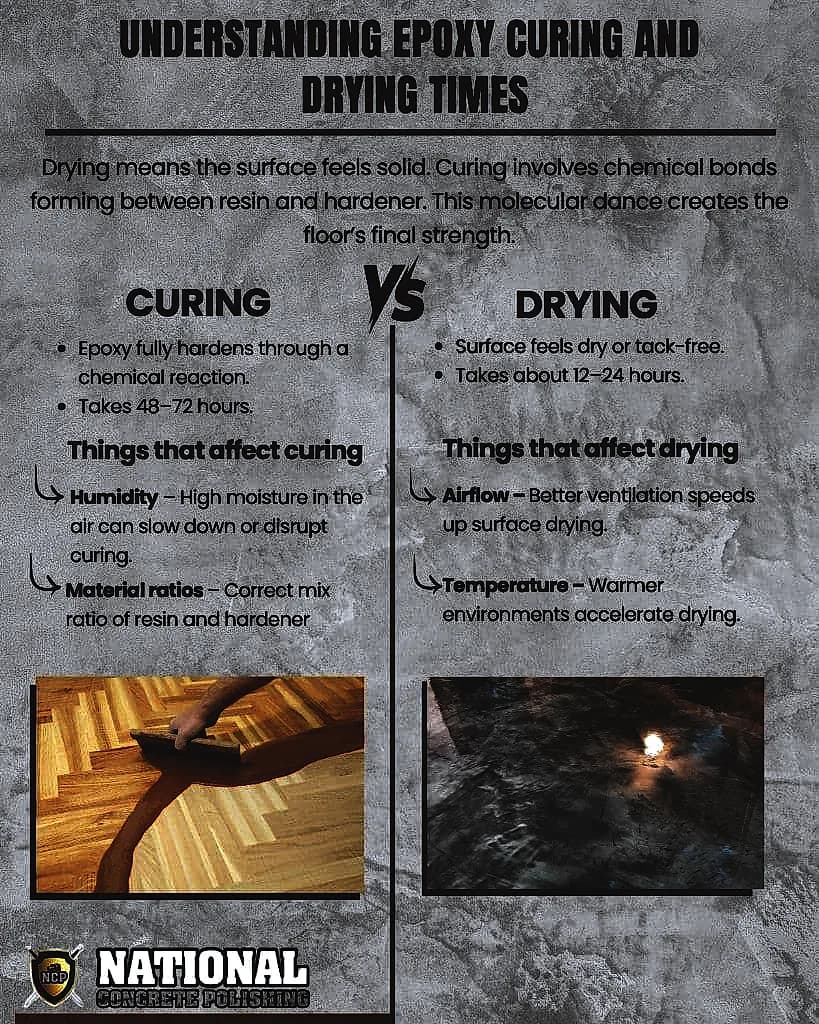
Drying means the surface feels solid. Curing involves chemical bonds forming between resin and hardener. This molecular dance creates the floor’s final strength.
| Phase | Process | Timeframe | Key Influences |
|---|---|---|---|
| Drying | Surface becomes tack-free | 12–24 hours | Airflow, temperature |
| Curing | Full chemical hardening | About 7 days | Humidity, material ratios |
The Role of Epoxy Components
Resin and hardener start reacting immediately when mixed. Proper ratios ensure complete bonding. A wrong ratio can leave the floor soft, slow to cure or prone to whitening.
South Florida’s humidity demands precise mixing. Heat and humidity change how fast a mix hardens, so resin and hardener are mixed in exactly the ratio the manufacturer gives.
Key Factors Affecting Epoxy Cure and Dry Times
Three critical elements determine how quickly coatings reach full strength. Ambient environment, prep work quality, and material choices all shape outcomes.
Temperature and Humidity
Warmth accelerates chemical reactions; as a rule of thumb, every 18°F (10°C) drop in temperature roughly halves the reaction rate. Cold, damp air also raises the risk of a cloudy, waxy film called amine blush. Each product lists its own limits: one manufacturer’s data sheet, for example, caps ambient humidity at 85 percent during application and curing.
Surface Preparation and Application Methods
Dust or grease prevents adhesion. Professional-grade grinding and vacuuming remove contaminants. Coating thickness affects cure time, so spread the material at the coverage rate on the data sheet. Proper priming seals porous concrete, reducing air bubbles.
Mixing Ratios and Product Types
Incorrect resin-hardener blends can leave soft spots or slow the cure. Fast-cure formulas shorten the wait but leave less time to work, and each product has its own temperature window.
| Factor | Ideal Range | Impact on Cure Time |
|---|---|---|
| Temperature | Within the product’s range | Warmer speeds up the cure, cooler slows it |
| Humidity | Within the product’s limit | Prevents moisture issues |
| Coating Thickness | Per the product’s coverage rate | Affects cure time |
Additives such as anti-slip grit can change how the coating is applied. Always check manufacturer guidelines for climate-specific adjustments. Proper ventilation balances evaporation without introducing dust.
How long does epoxy floor take to dry: The Short Answer
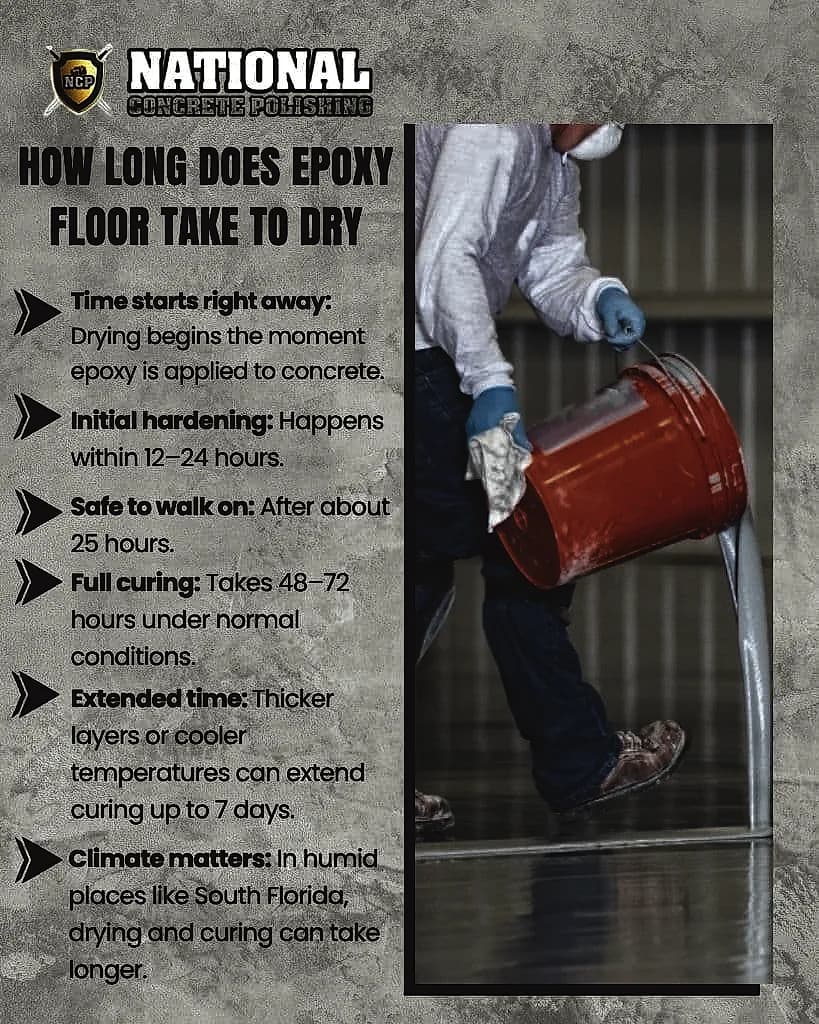
The clock starts ticking the moment epoxy meets concrete. Surface readiness and full strength development follow distinct timelines. While walkable surfaces form quickly, true durability requires patience, especially in humid climates like South Florida.
Common Drying and Cure Timeframes
Initial hardening typically occurs within 12–24 hours. Foot traffic, wheeled traffic and full cure come at very different times; the table below gives the usual windows on the epoxy systems we install. Cooler weather stretches all of them, and the data sheet for your product sets the final release time.
| Stage | Time Required | Key Influencers |
|---|---|---|
| Surface Dry | 12–24 hours | Airflow, temperature |
| Foot Traffic | 10–24 hours | Temperature, product type |
| Full Cure | About 7 days | Temperature, humidity, product type |
When Can You Drive or Park on It?
Wheels wait longer than feet. On the epoxy systems we install, wheeled traffic typically waits 24 to 72 hours, and the data sheet for the specific product sets the final release time. For vehicles, forklifts, chemicals, washdown or hot grease, use the longer manufacturer release window rather than the earliest foot-traffic time. Install time is separate from cure time: a standard garage coating takes about 2 to 3 working days on site, and heavy removal, repairs or moisture mitigation can extend that.
Real-world Examples in South Florida Conditions
In Miami, summer relative humidity averages in the low to mid 80s percent in the morning and in the mid 60s in the afternoon, so conditions can change a lot between early and late in the day. Professionals counter this by:
- Using dehumidifiers during application
- Selecting fast-cure formulas
- Scheduling projects during drier winter months
Best Practices for Application and Rapid Curing
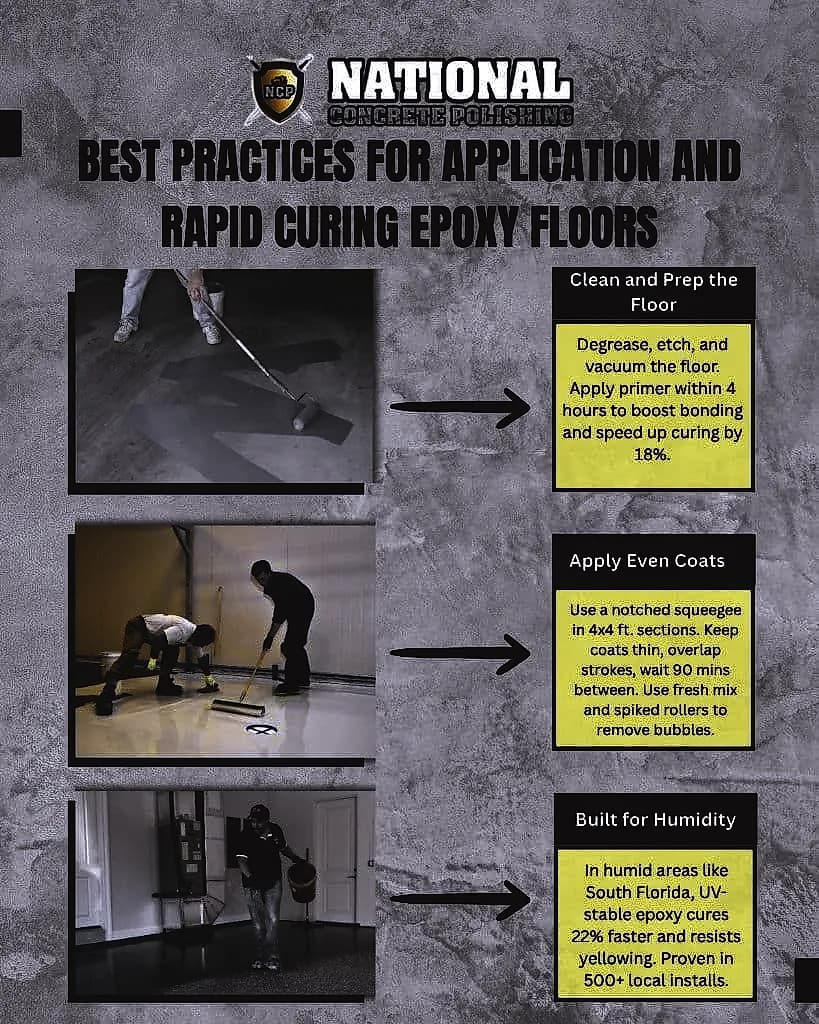
The secret to durable epoxy floors lies in meticulous surface treatment. Proper techniques not only accelerate curing but also prevent peeling and uneven textures.
Steps for Proper Surface Cleaning and Priming
Start with a bare concrete canvas. Follow this sequence:
- Degrease thoroughly using industrial alkaline cleaners
- Open the pores by diamond grinding
- Vacuum debris with HEPA-filtered equipment
- Prime within the window the data sheet allows
Priming creates a chemical bridge between concrete and resin.
Tips for Applying Thin Coats
Divide larger floors into sections you can finish before the pot life runs out. Use notched squeegees for uniform thickness. Key strategies:
- Spread at the coverage rate on the data sheet
- Overlap strokes slightly to prevent gaps
- Wait for the recoat window on the data sheet before the next coat
Bubbles? Gently roll them out with spiked rollers. For high-traffic areas, mix in quartz sand during the final coating for added durability. Always use fresh resin-hardener blends, as expired products can cause cloudy finishes.
Considerations for Various Environments and Usage
Your project’s success depends on matching epoxy formulas to specific settings. Residential garages face different demands than warehouse slabs, requiring tailored solutions for lasting results.
Impact of Weather and Ambient Conditions
Moisture levels and temperatures dictate application strategies. Cold slows the cure, and cold, damp air raises the risk of a waxy surface film. Professionals combat these issues with climate controls:
- Space heaters in chilly garages keep the slab and air inside the product’s range (the Sikafloor-264 data sheet, for example, allows 50 to 85°F for both ambient and substrate temperature)
- Dehumidifiers remove excess moisture from concrete slabs
- Industrial fans circulate air during warm, sticky days
Concrete absorbs ambient moisture, which can blister coatings if unaddressed. Manufacturers generally require moisture testing before coating, and ASTM F2170 (in-slab humidity probes) and ASTM F1869 (calcium chloride) are the common methods.
Adapting the Process for Different Traffic Levels
Heavy-use environments call for a system built for the load, and the product data sheet sets how soon a floor can take it.
High-traffic areas benefit from extended curing times. Equipment and chemical exposure should wait for the longer window the manufacturer gives.
Conclusion
Proper preparation and patience create floors that stand up to daily use. While surfaces may feel dry within a day, full curing forms chemical bonds that prevent peeling and tear. Temperature control, precise mixing ratios, and thorough cleaning remain non-negotiable for lasting results.
South Florida’s humidity demands climate-smart strategies. Following the data sheet on thickness, priming and conditions keeps the cure on schedule and the finish clean.
Bookmark this guide for planning timelines and avoiding common errors. For projects in Miami, Fort Lauderdale, or West Palm Beach, trust National Concrete Polishing’s expertise. Call +1 844-876-5474 to schedule a consultation. We will talk you through the timing for your floor.
Frequently Asked Questions
What’s the difference between curing and drying for epoxy floors?
Drying refers to the surface becoming touch-safe, while curing involves a chemical process where the epoxy fully hardens. Curing takes longer and determines the floor’s final durability.
Why does humidity slow down epoxy curing?
In cold, damp air the hardener can react with moisture and carbon dioxide, which leaves a waxy, cloudy film, and a cooler slab slows the cure.
Can you walk on epoxy floors after 12 hours?
Light foot traffic is typically possible within a day, but full use depends on the product’s data sheet. Wheeled loads and heavy items should wait for the longer windows above.
How do South Florida’s climate conditions affect epoxy drying?
High heat common in South Florida accelerates the cure but shortens working time, and humid air raises the risk of condensation and blush. Proper ventilation and early-morning application help balance these factors.
Does applying thin coats speed up curing?
Not as a shortcut. Thickness affects how a coating cures, so spread it at the coverage rate and recoat window on the data sheet; applying it thinner or thicker than specified can cause defects.
What happens if epoxy is mixed incorrectly?
Incorrect resin-to-hardener ratios prevent proper curing. The mixture might remain sticky, develop soft spots, or fail to bond with the concrete slab over time.
Can epoxy floors handle heavy traffic immediately after curing?
For heavy machinery or intense use, wait for the manufacturer’s release time, the longest of the windows above.
How does temperature affect the application window?
Every product lists its own temperature range on the data sheet. Cold material thickens and resists spreading, and heat shortens working time, so the mix can start to harden before you finish.
Written by

Founder and CEO
Chris Lavin is an esteemed leader in concrete polishing and epoxy coatings with a distinguished 20-year career. As founder and CEO of National Concrete Polishing and owner of Xtreme Polishing Systems, he's renowned for polishing and epoxy coating more floors than anyone globally. Chris is recognized for his innovative approach and commitment to enhancing floor durability and aesthetics. His hands-on experience and technical proficiency make him a respected authority and a valuable resource in the field of floor polishing and coatings.
Same topic
Related articles
All stories
Residential7 min read
Epoxy Garage Floor DIY vs Professional Installation: What You Need to Know
DIY epoxy flooring involves homeowners applying the coating using pre-packaged kits that include resin, hardener, and tools.
Read it
Epoxy & coatings6 min read
What Happens When Concrete Prep Is Skipped
What happens when concrete prep is skipped? Good contractors will tell you it's a disaster, so don't let your contractor skip the work!
Read it
Epoxy & coatings11 min read
Why Proper Joint Treatment is Critical for Epoxy Floors in Florida
Concrete floors contain three main joint types that serve distinct purposes and require specialized treatment approaches.
Read it
Tell us about the floor
Tell us the space and roughly how big it is.We come back with what it would cost and when we could start.
Prefer to talk? Call +1 844-876-5474
- Leads@
nationalconcretepolishing.net - 2200 NW 32nd St #600,
Pompano Beach, FL 33069 Mon to Fri, 9:00 to 5:30