
The NCP blog
Stamped Concrete vs Pavers in South Florida: Which Surface Holds Up Better
Polished concrete10 min read
However, pavers remain the preferred choice for pool decks and areas requiring frequent underground access.
When comparing stamped concrete vs pavers South Florida homeowners need to consider how each material responds to the region’s unique environmental stresses. Stamped concrete offers a seamless, lower-maintenance surface that resists weed growth and ant infiltration, while pavers provide easier spot repairs but require more ongoing maintenance. According to the Interlocking Concrete Pavement Institute (ICPI), both materials can last 25-30 years in Florida’s climate when properly installed, but their performance characteristics differ significantly under hurricane conditions, intense UV exposure, and constant humidity.
The National Ready Mixed Concrete Association reports that stamped concrete installations have increased 340% in Florida over the past decade, largely due to lower long-term maintenance costs. However, pavers remain the preferred choice for pool decks and areas requiring frequent underground access. This comprehensive comparison examines durability, cost, maintenance, and climate performance to help South Florida property owners make informed decisions.
Durability in South Florida’s Climate
South Florida’s combination of intense heat, salt air, heavy rainfall, and hurricane-force winds creates demanding conditions for any outdoor surface. Understanding how stamped concrete and pavers respond to these specific stressors determines which material offers superior long-term performance for your property.
Hurricane and Storm Resistance
Stamped concrete’s monolithic structure provides superior wind resistance during tropical storms. The Federal Emergency Management Agency (FEMA) notes that properly installed concrete slabs remain intact at wind speeds exceeding 150 mph, while individual pavers can become dangerous projectiles at speeds above 90 mph. During Hurricane Irma in 2017, Miami-Dade County building inspectors documented over 12,000 instances of paver displacement compared to fewer than 800 stamped concrete failures.
However, pavers offer an advantage in flood-prone areas. Permeable paver systems allow water to drain through joints at rates up to 100 inches per hour, reducing surface flooding during intense rainfall. Stamped concrete, being impermeable, requires proper grading and drainage systems to prevent water accumulation. South Florida’s average annual rainfall of 62 inches makes this consideration particularly important for low-lying properties.
Heat and UV Exposure
South Florida surfaces endure over 3,000 hours of direct sunlight annually, with summer surface temperatures regularly exceeding 140°F. According to the Portland Cement Association, stamped concrete with UV-stable sealers maintains color integrity for 5-7 years before requiring resealing. Standard concrete colorants can fade 20-30% within 3 years without proper UV protection.
Pavers manufactured with integral color (pigment mixed throughout the material) resist fading better than surface-colored alternatives. Premium pavers from manufacturers like Belgard and Tremron maintain 90% color retention over 10 years. However, the polymeric sand between pavers degrades under UV exposure and typically requires replacement every 3-5 years in South Florida.
Salt Air and Coastal Exposure
Properties within 5 miles of the Atlantic Ocean or Gulf of Mexico face accelerated material degradation from airborne salt. Research from Florida International University indicates that chloride penetration reduces concrete surface hardness by 15-25% over 10 years in coastal environments. Proper sealing with penetrating sealers blocks chloride intrusion and extends stamped concrete lifespan significantly.
Pavers’ individual nature means salt damage affects smaller areas that can be replaced without disturbing the entire surface. However, the sand joints between pavers absorb and retain salt, accelerating efflorescence (white salt deposits) that requires regular cleaning. Coastal properties often see efflorescence appear within 6-12 months of paver installation.
Cost Comparison: Installation and Long-Term
Total cost of ownership extends far beyond initial installation. South Florida’s environmental conditions create ongoing maintenance requirements that significantly impact lifetime costs for both stamped concrete and pavers.
Installation Costs
Stamped concrete installation in South Florida typically ranges from $12-$20 per square foot, including base preparation, concrete pouring, stamping, coloring, and initial sealing. Complex patterns, multiple colors, and borders increase costs to $18-$25 per square foot. A standard 1,000 square foot driveway costs $12,000-$20,000 installed.
Paver installation ranges from $15-$30 per square foot depending on material quality and pattern complexity. Budget pavers start at $15-$18 per square foot, mid-range options at $20-$25, and premium tumbled or textured pavers at $25-$30. The same 1,000 square foot driveway costs $15,000-$30,000 with pavers, making initial installation 25-50% more expensive than stamped concrete.
Ongoing Maintenance Costs
Stamped concrete requires resealing every 2-3 years in South Florida’s harsh conditions. Professional resealing costs $1.50-$2.50 per square foot, totaling $1,500-$2,500 for a 1,000 square foot surface. Over a 25-year lifespan, expect to spend $12,000-$20,000 on sealing alone.
Pavers require polymeric sand replacement every 3-5 years at $2-$4 per square foot ($2,000-$4,000 per application). Weed removal, ant treatment, and leveling repairs add $500-$1,500 annually. Professional cleaning and re-sanding every few years costs an additional $3-$5 per square foot. Total 25-year maintenance costs typically range from $20,000-$35,000, significantly higher than stamped concrete.
Repair Costs
Paver repairs offer a clear advantage: individual units can be replaced for $5-$15 each plus labor. Settling issues require lifting and releveling at $3-$6 per square foot. Total repair costs remain predictable and localized.
Stamped concrete crack repair presents challenges. Minor cracks can be filled and resealed for $200-$500, but matching existing color and pattern proves difficult. Major cracks or settling often require section replacement at $15-$25 per square foot, and color matching original work is nearly impossible. Professional concrete resurfacing offers an alternative at $4-$8 per square foot when surfaces become severely damaged.
Complete Cost Comparison Table
The following table compares all cost factors for stamped concrete and pavers in South Florida over a 25-year period:
| Cost Factor | Stamped Concrete | Pavers |
|---|---|---|
| Installation (per sq ft) | $12-$25 | $15-$30 |
| Sealing/Sand (25 years) | $12,000-$20,000 | $10,000-$20,000 |
| Annual Maintenance | $100-$300 | $500-$1,500 |
| Typical Repair Cost | $200-$2,500 | $50-$500 |
| 25-Year Total (1,000 sq ft) | $27,000-$50,000 | $40,000-$75,000 |
| Expected Lifespan | 25-30 years | 25-30 years |
Maintenance Requirements in South Florida
Stamped Concrete Maintenance
Routine cleaning requires only pressure washing at 2,500-3,000 PSI every 3-6 months to remove mold, mildew, and organic staining common in South Florida’s humid environment. Avoid using harsh chemicals that can strip sealers prematurely.
Resealing every 2-3 years protects against UV damage, moisture penetration, and color fading. South Florida’s intense sun degrades sealers faster than northern climates. Water-based acrylic sealers offer easier application but require more frequent renewal. Solvent-based polyurethanes last longer but cost more and have stronger odors during application.
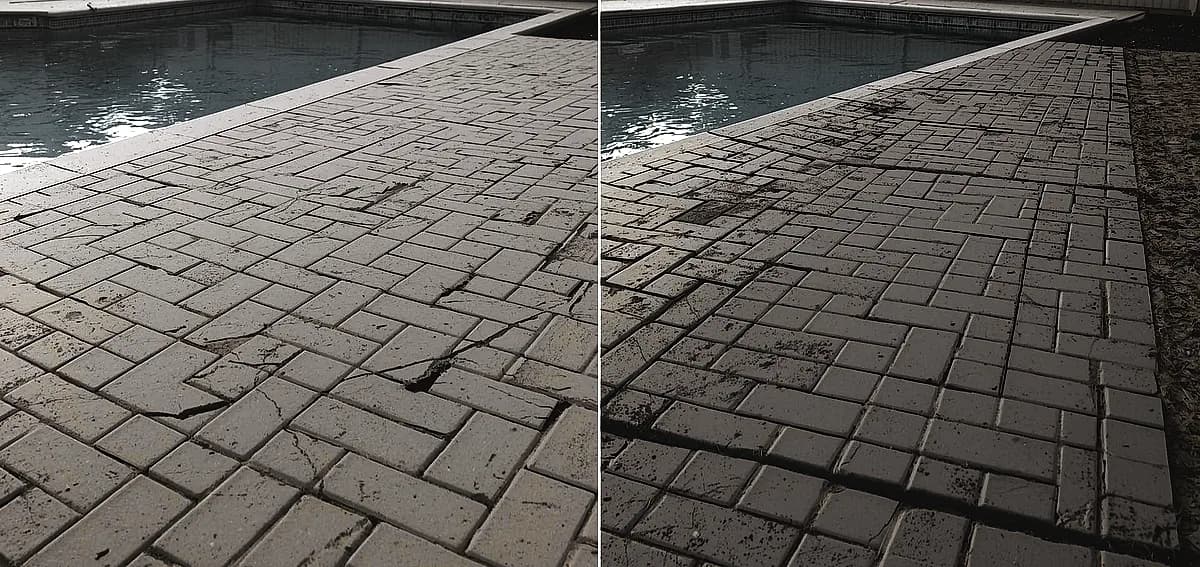
Crack monitoring should occur annually. Hairline cracks under 1/8 inch typically don’t require immediate repair but should be sealed during the next resealing cycle. Wider cracks indicate potential base issues requiring professional assessment.
Paver Maintenance
Weed and ant control represents the primary ongoing challenge. South Florida’s year-round growing season means weeds emerge continuously through joint sand. Fire ants establish colonies beneath pavers within months of installation. Chemical treatments, polymeric sand replacement, and physical removal require constant attention.
Joint sand maintenance involves replacing polymeric sand every 3-5 years as it degrades from UV exposure and washes out during heavy rains. South Florida’s 62 inches of annual rainfall accelerates this degradation. Failing to maintain joint sand leads to paver shifting, weed infiltration, and ant colonization.
Leveling adjustments become necessary as South Florida’s sandy, often poorly compacted soils shift over time. Individual pavers sink or heave, creating trip hazards and water pooling. Professional releveling costs $3-$6 per square foot and may be needed every 5-10 years in problematic areas.
Sealing (optional) enhances color and provides some protection against staining but isn’t strictly necessary for pavers as it is for stamped concrete. When applied, paver sealers require renewal every 3-5 years at similar costs to stamped concrete sealing.
Aesthetic Options and Design Flexibility
Stamped Concrete Design Options
Modern stamped concrete replicates natural stone, brick, slate, wood planks, and custom patterns with remarkable accuracy. The American Society of Concrete Contractors documents over 200 standard stamp patterns available, with custom designs possible for unique applications. Color options include integral coloring (mixed throughout), surface-applied color hardeners, and antiquing release agents that create depth and dimension.
Popular South Florida patterns include Mediterranean tile, coral stone, travertine, and brick herringbone. Decorative concrete techniques allow borders, multiple pattern combinations, and color gradients that would be prohibitively expensive with actual pavers. The seamless surface creates a unified aesthetic that many South Florida homeowners prefer for contemporary architecture.
Paver Design Options
Pavers offer authentic texture and dimensional variation that stamped concrete mimics but cannot fully replicate. Each paver is a discrete unit with natural color variations, creating visual depth impossible to achieve with stamped surfaces. Premium tumbled pavers develop patina over time, enhancing their aged appearance.
Layout flexibility allows intricate patterns including herringbone, basketweave, running bond, circular designs, and custom mosaics. Pavers can incorporate contrasting border colors, medallion inserts, and directional patterns. South Florida’s Spanish and Mediterranean architectural traditions pair naturally with clay and concrete paver aesthetics.
Performance Comparison by Application
Different applications favor different materials. This table identifies the better choice for common South Florida uses:
| Application | Better Choice | Reason | Alternative Benefit |
|---|---|---|---|
| Driveways | Stamped Concrete | No shifting under vehicle weight | Pavers allow utility access |
| Pool Decks | Pavers | Easy access for plumbing repairs | Stamped concrete has fewer joints for debris |
| Patios | Either | Both perform well; aesthetic preference | Stamped for budget; pavers for traditional look |
| Walkways | Stamped Concrete | Smooth surface for accessibility | Pavers offer design flexibility |
| Commercial Areas | Stamped Concrete | Lower maintenance; no trip hazards | Pavers easier for utility repairs |
| Flood-Prone Areas | Permeable Pavers | 100+ in/hr drainage rate | Stamped requires extensive drainage work |
Best Applications for Each Material
Choose Stamped Concrete When
Budget optimization matters. Stamped concrete costs 25-50% less than pavers initially and saves $10,000-$25,000 in maintenance over 25 years. The total cost of ownership makes stamped concrete the clear financial winner for most residential applications.
Low maintenance is priority. Stamped concrete requires only occasional pressure washing and resealing every few years. No weed pulling, no ant treatments, no leveling adjustments. For busy homeowners or rental properties, this simplicity has significant value.
Hurricane resistance is essential. Properties in high-wind zones benefit from stamped concrete’s monolithic structure. The surface won’t become airborne debris during tropical storms, eliminating a significant safety concern.
Contemporary aesthetics appeal. Modern South Florida architecture often features clean lines and seamless surfaces that stamped concrete delivers. Large-format patterns and unified color schemes complement minimalist design approaches.
Choose Pavers When
Underground utilities need access. Pool decks, areas with sprinkler systems, and properties with frequent plumbing issues benefit from pavers’ removable nature. Accessing underground pipes without destroying the surface saves thousands in repair costs.
Drainage is problematic. Low-lying properties in South Florida’s flood-prone areas benefit from permeable paver systems. These installations can satisfy local stormwater management requirements while providing functional outdoor surfaces.
Traditional aesthetics are desired. Spanish colonial, Mediterranean, and traditional Florida architectural styles pair naturally with clay and tumbled concrete pavers. The authentic texture and dimensional variation complement historic preservation districts and classic home designs.
DIY repair capability matters. Handy homeowners can replace individual pavers, add polymeric sand, and perform basic leveling without professional assistance. This self-sufficiency appeals to those who prefer hands-on property maintenance.
Frequently Asked Questions
Which lasts longer in South Florida: stamped concrete or pavers?
Both materials last 25-30 years when properly installed and maintained. The key difference is failure mode: stamped concrete may develop cracks that are difficult to repair invisibly, while pavers may shift or settle but can be easily releveled. Properties with stable soil conditions favor stamped concrete longevity, while those with sandy or problematic soils may find pavers easier to maintain long-term.
Do stamped concrete and pavers get equally hot in South Florida sun?
Surface temperatures are comparable for similar colors. Light-colored options in both materials stay 20-30°F cooler than dark colors. Pavers with textured surfaces may feel slightly cooler due to air circulation between units. For pool decks where barefoot comfort matters, light gray or tan shades in either material perform best. Special cool-deck coatings can reduce stamped concrete temperatures by 15-20°F.
Can I convert my existing stamped concrete to pavers or vice versa?
Converting pavers to stamped concrete requires removing existing pavers, excavating additional depth, installing proper base material, and pouring new concrete. Total cost runs $18-$28 per square foot. Converting stamped concrete to pavers involves demolishing existing concrete ($3-$5 per square foot), preparing the base, and installing new pavers. This conversion typically costs $20-$35 per square foot total. In most cases, concrete resurfacing or overlay is more cost-effective than full replacement.
Are stamped concrete or pavers more slippery when wet?
Standard stamped concrete with acrylic sealer can be slippery when wet. Adding anti-slip additives to sealers or using textured stamps improves traction. Pavers with textured surfaces provide better wet grip naturally, though sealed pavers can become slippery. For pool decks and other areas where wet conditions are common, specify non-slip sealers or choose textured paver options.
How do stamped concrete and pavers affect property value in South Florida?
According to the National Association of Realtors, quality hardscape improvements return 50-75% of investment at resale. Both stamped concrete and pavers are considered premium finishes that enhance curb appeal. High-end pavers may command slightly higher perceived value in luxury markets, while well-maintained stamped concrete appeals to buyers seeking lower-maintenance properties. Condition matters more than material choice for resale value.
What is the best time of year to install stamped concrete or pavers in South Florida?
The dry season from November through April offers optimal installation conditions for both materials. Stamped concrete particularly benefits from lower humidity, which allows better color development and sealer application. Paver installation is less weather-sensitive but still easier during dry months. Summer installations require careful scheduling around afternoon thunderstorms and may need covered work areas for stamped concrete color application.
Professional Concrete and Hardscape Services in South Florida
National Concrete Polishing provides expert consultation and installation for all types of decorative concrete surfaces throughout South Florida. Our experienced team helps property owners choose the right material for their specific applications, budget, and aesthetic preferences.
From concrete resurfacing to new decorative installations, we deliver durable, beautiful results engineered for South Florida’s demanding climate. Every project includes proper moisture testing, professional base preparation, and climate-appropriate installation timing.
Contact our team for a free consultation and estimate. We serve Miami, Fort Lauderdale, Pompano Beach, Port St. Lucie, and all of South Florida.
Written by

Founder and CEO
Chris Lavin is an esteemed leader in concrete polishing and epoxy coatings with a distinguished 20-year career. As founder and CEO of National Concrete Polishing and owner of Xtreme Polishing Systems, he's renowned for polishing and epoxy coating more floors than anyone globally. Chris is recognized for his innovative approach and commitment to enhancing floor durability and aesthetics. His hands-on experience and technical proficiency make him a respected authority and a valuable resource in the field of floor polishing and coatings.
Same topic
Related articles
All stories
Polished concrete11 min read
Polished Concrete vs Epoxy Coatings: Which Floor Is Right for Your Space?
Two systems, two price curves, one slab. What each one costs to install and to keep, and which spaces each one actually suits.
Read it
Polished concrete8 min read
What to Know Before Polishing Your Existing Concrete Slab
Before any mechanical refinement can begin, a thorough evaluation of the current foundation is required.
Read it
Polished concrete8 min read
Is Polished Concrete Worth the Investment for Miami Properties?
It is essential to distinguish between a simple topical seal and mechanically refined concrete.
Read it
Tell us about the floor
Tell us the space and roughly how big it is.We come back with what it would cost and when we could start.
Prefer to talk? Call +1 844-876-5474
- Leads@
nationalconcretepolishing.net - 2200 NW 32nd St #600,
Pompano Beach, FL 33069 Mon to Fri, 9:00 to 5:30