
The NCP blog
Stamped Concrete vs Pavers in Miami: Which Option Fits Your Budget and Style
Cost & ROI9 min read
Stamped concrete costs $8-$18 per square foot installed, while pavers range from $15-$30 per square foot.
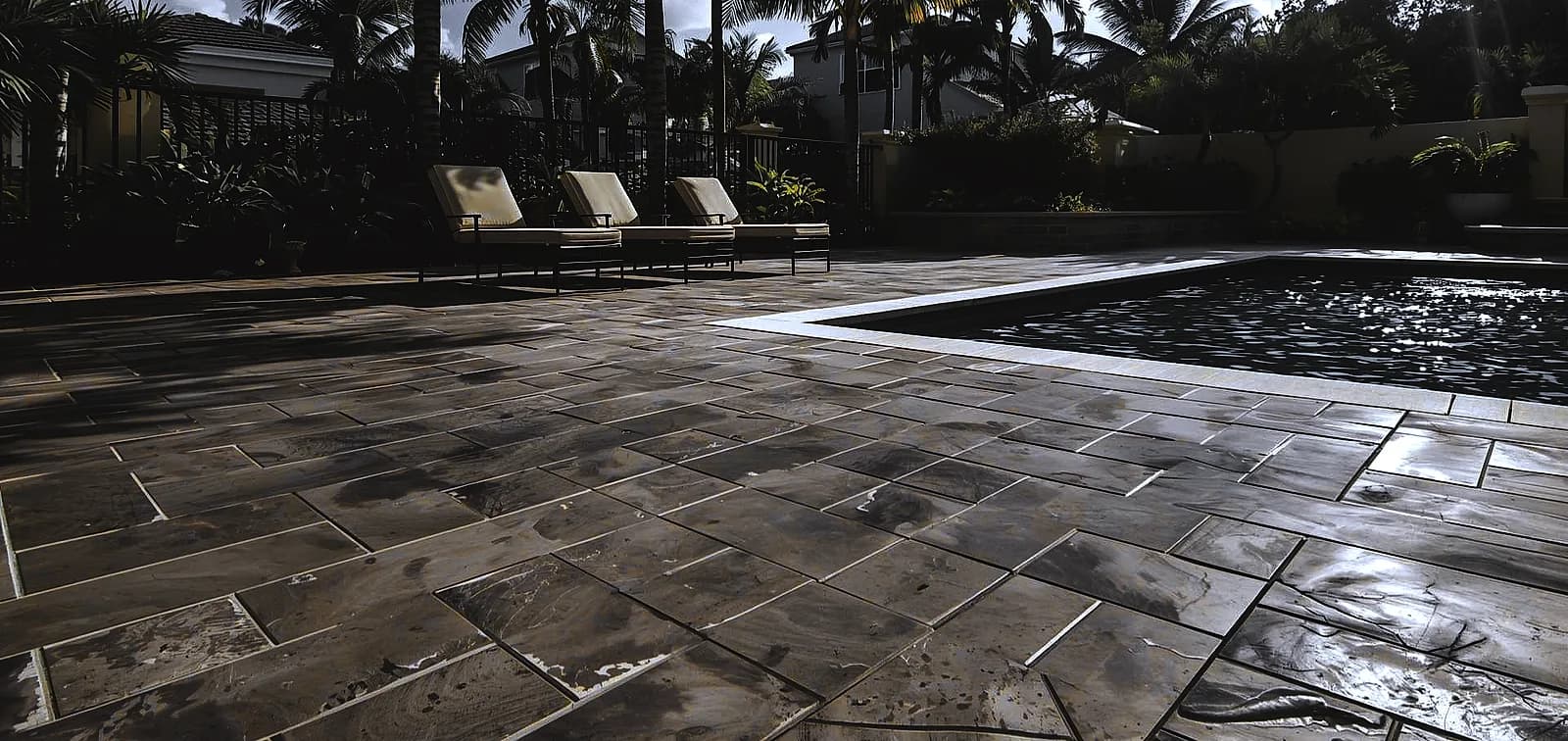
Choosing between stamped concrete vs pavers Miami comes down to budget, maintenance preferences, and long-term durability in South Florida’s demanding climate. Stamped concrete costs $8-$18 per square foot installed, while pavers range from $15-$30 per square foot. According to the Interlocking Concrete Pavement Institute (ICPI), both materials can last 25-30 years when properly installed, but Miami’s unique combination of 60+ inches annual rainfall, salt air exposure, and year-round UV radiation affects each material differently.
This comprehensive comparison covers installation costs, maintenance requirements, repair considerations, and aesthetic options to help Miami homeowners make an informed decision for driveways, patios, pool decks, and walkways.
Stamped Concrete vs Pavers: Quick Comparison
The following table summarizes the key differences between stamped concrete and pavers for Miami applications:
| Factor | Stamped Concrete | Pavers |
|---|---|---|
| Initial Cost | $8-$18/sq ft | $15-$30/sq ft |
| Installation Time | 1-3 days + 7-day cure | 3-7 days, immediate use |
| Lifespan | 25-30 years | 25-50 years |
| Maintenance | Reseal every 2-3 years | Joint sand replacement, weed control |
| Repair Difficulty | Difficult (patches visible) | Easy (individual replacement) |
| Cracking Risk | Moderate (control joints help) | Low (flexible system) |
| Heat Retention | High (gets very hot) | Moderate (joint gaps help) |
| Best For | Budget projects, large areas | Premium aesthetics, easy repairs |
Cost Breakdown: Stamped Concrete vs Pavers in Miami
Understanding total project costs requires looking beyond initial installation to include long-term maintenance, repairs, and potential replacement expenses.
Stamped Concrete Costs
Basic stamped concrete in Miami runs $8-$12 per square foot for single-color applications with standard patterns. Premium installations featuring multiple colors, complex patterns, or hand-stained details reach $15-$18 per square foot. The American Concrete Institute reports that Miami-area contractors typically charge 15-20% more than national averages due to humidity-related installation challenges and specialized sealer requirements.
For a typical 500 square foot Miami driveway, expect total costs of $4,000-$9,000 depending on design complexity. This includes site preparation, concrete pouring, stamping, coloring, and initial sealing. Learn more about concrete project pricing in our cost to epoxy a floor guide for comparative reference.
Paver Costs
Standard concrete pavers cost $15-$20 per square foot installed in Miami. Premium materials like travertine, natural stone, or porcelain pavers range from $25-$40 per square foot. The same 500 square foot driveway costs $7,500-$20,000 with pavers, depending on material selection.
Paver pricing includes excavation, base preparation (typically 6 inches of compacted aggregate), edge restraints, joint sand, and sealing. Miami’s sandy soil conditions often require deeper base preparation than northern installations, adding 10-15% to base costs.
Long-Term Cost Comparison (10-Year Analysis)
Over a 10-year period, stamped concrete requires resealing every 2-3 years at $0.50-$1.50 per square foot, adding $1,500-$4,500 in maintenance costs for a 500 square foot area. Crack repairs, when needed, cost $300-$800 per occurrence and may not match perfectly.
Pavers require joint sand replacement every 3-5 years ($200-$500), occasional individual paver replacement ($50-$200 per occurrence), and optional resealing every 3-5 years ($0.75-$2.00 per square foot). Total 10-year maintenance typically runs $1,000-$3,500 for pavers versus $1,500-$5,000 for stamped concrete.
Durability in Miami’s Climate
Miami’s subtropical climate creates specific challenges for outdoor hardscaping. Both stamped concrete and pavers face constant UV exposure, heavy rainfall, salt air (especially within 5 miles of the coast), and occasional tropical storm impacts.
How Stamped Concrete Performs
Stamped concrete’s primary vulnerability in Miami is sealer degradation. The Concrete Network reports that UV exposure in South Florida breaks down acrylic sealers 40% faster than in northern climates. Without proper resealing, colors fade, the surface becomes porous, and water infiltration leads to spalling damage.
Cracking remains a concern, though proper installation with control joints every 8-12 feet minimizes random cracking. Miami’s stable temperatures (no freeze-thaw cycles) actually benefit stamped concrete compared to northern installations. However, soil settlement from Florida’s sandy conditions can cause cracking that’s difficult to repair invisibly.
How Pavers Perform
Pavers excel in Miami’s climate due to their segmented, flexible design. When soil shifts or settles, individual pavers move independently rather than cracking. The ICPI rates properly installed interlocking pavers at 8,000+ PSI compressive strength, exceeding the 3,000-4,000 PSI of standard poured concrete.
Heavy Miami rainfall drains through paver joints when permeable systems are installed, reducing standing water and improving stormwater management. Miami-Dade County’s stormwater regulations increasingly favor permeable paving solutions, making pavers attractive for new construction.
Salt air affects both materials, but pavers allow easier remediation. Individual discolored or damaged pavers can be replaced without disturbing surrounding areas.
Style and Design Options
Stamped Concrete Aesthetics
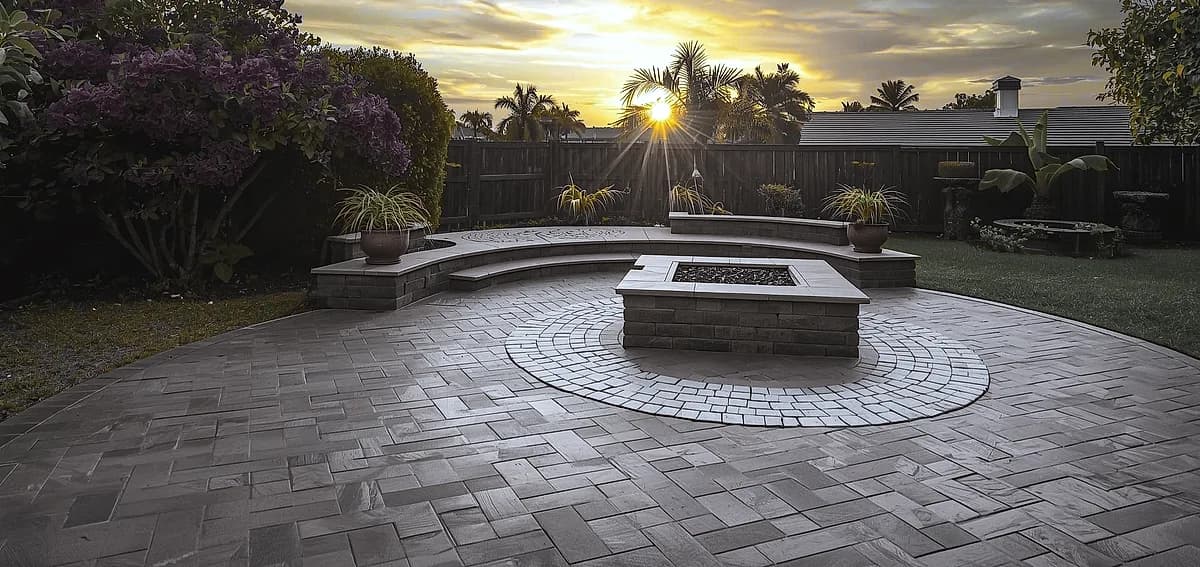
Stamped concrete offers virtually unlimited pattern options, from natural stone and brick replications to custom geometric designs. Popular Miami patterns include Ashlar slate, cobblestone, herringbone brick, and random stone. Color options span the entire spectrum, with integral coloring, surface-applied color hardeners, and accent stains creating multi-tonal effects.
The seamless, monolithic appearance of stamped concrete appeals to modern Miami architecture. Large patios and pool decks benefit from the continuous surface without visible joints. For creative design inspiration, explore our decorative concrete options.
Paver Aesthetics
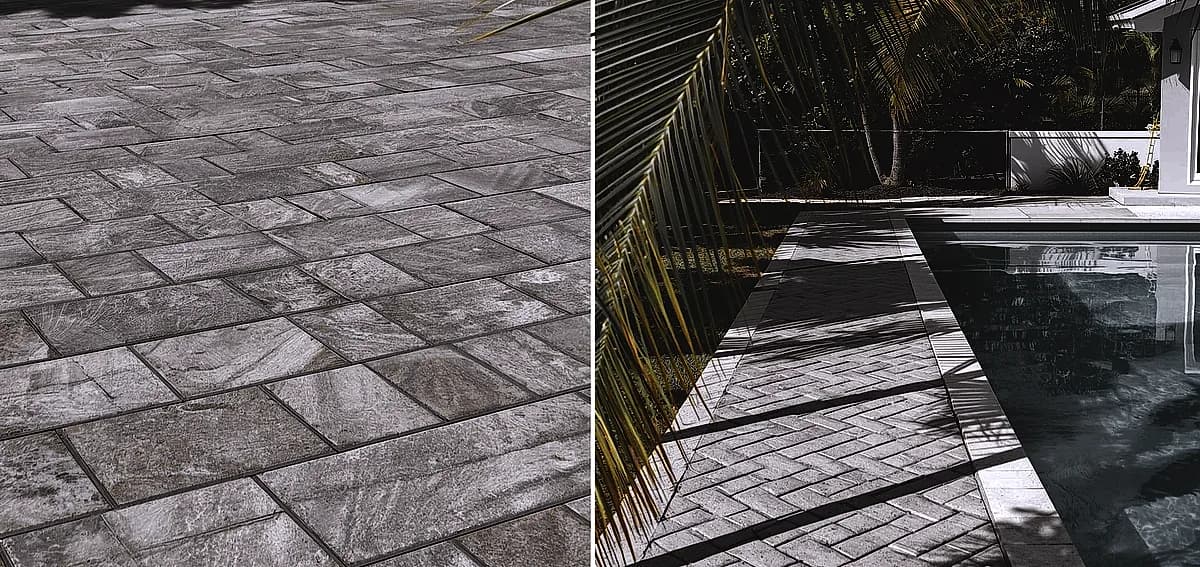
Pavers provide authentic texture and dimensional depth that stamped concrete imitates but cannot fully replicate. Natural stone pavers (travertine, coral stone, slate) offer unique character with each piece. Manufactured concrete pavers now achieve remarkably realistic stone appearances with consistent sizing for easier installation.
Miami’s Mediterranean, contemporary, and tropical architectural styles pair well with specific paver selections. Travertine pavers dominate luxury pool deck installations due to their natural coolness underfoot and elegant appearance. Coral stone pavers connect to Florida’s native geology and local building traditions.
Design Options Comparison
| Design Element | Stamped Concrete | Pavers |
|---|---|---|
| Patterns | Unlimited (stamp mats) | Based on paver shapes/sizes |
| Colors | Custom mixed, multi-tone possible | Manufacturer palettes, natural stone |
| Texture | Simulated (stamps) | Authentic dimensional |
| Border Options | Contrasting stamp/color | Different paver type/color |
Application-Specific Recommendations for Miami
Driveways
Recommended: Pavers for luxury homes, stamped concrete for budget-conscious projects. Miami driveways face vehicle traffic, oil drips, and constant sun exposure. Pavers handle vehicle weight better due to their flexible base system, and individual pavers can be replaced if oil staining occurs. Stamped concrete driveways work well for single-family homes with lighter vehicle traffic, offering 40-50% cost savings.
Pool Decks
Recommended: Travertine pavers or cool-deck stamped concrete. Pool deck surfaces must remain comfortable underfoot in Miami’s intense summer sun. Standard stamped concrete can reach 150°F+ surface temperatures. Cool-deck additives reduce temperatures by 20-30%, but travertine pavers naturally stay 20-40% cooler than concrete alternatives.
Both options require slip-resistant finishes for wet areas. Stamped concrete receives textured sealer applications, while pavers provide natural texture through their manufacturing process. Explore pool deck options in our pool deck resurfacing guide.
Patios
Recommended: Either option works well; choose based on design preference. Covered patios see less UV degradation, making stamped concrete’s lower cost more attractive. Uncovered patios benefit from pavers’ easier drainage and cooler surface temperatures. Large patios (500+ square feet) often combine both materials, with stamped concrete as the field and paver borders for design interest.
Walkways and Pathways
Recommended: Pavers for tree root areas, stamped concrete for clear paths. Miami’s mature landscaping often includes tree roots that can crack concrete surfaces. Pavers can be lifted, roots trimmed, and pavers reset without visible damage. Stamped concrete walkways in root-free areas provide seamless appearance and lower initial cost.
Installation Considerations in Miami
Best Installation Timing
Miami’s dry season (November through April) provides optimal conditions for both materials. Stamped concrete requires 7 days without rain for proper curing, making wet season installation risky. The Florida Building Code requires concrete placement when temperatures remain above 50°F for 72 hours, rarely an issue in Miami.
Pavers can be installed year-round, though heavy afternoon rain delays daily progress. Professional crews typically complete paver installation 50% faster during dry season. Understanding how humidity affects installation helps homeowners plan projects appropriately.
Permit Requirements
Miami-Dade County requires permits for driveway installations and any hardscape exceeding 200 square feet. Both stamped concrete and pavers must meet county stormwater management requirements. Permeable paver systems may qualify for reduced permit fees and faster approval in areas with strict drainage regulations.
Contractor Selection
Stamped concrete requires specialized stamping skills that differ from standard flatwork. Request photos of recent stamped concrete projects in similar patterns. Color consistency across large areas demands experienced crews who understand timing in Miami’s fast-drying conditions.
Paver installation requires ICPI certification for warranty coverage from major manufacturers. Verify contractor insurance, licensing, and pull recent references. Base preparation determines long-term performance, so ask specifically about compaction methods and base material specifications.
Maintenance Requirements Comparison
Stamped Concrete Maintenance
Resealing: Apply acrylic or polyurethane sealer every 2-3 years. Miami’s UV intensity may require annual resealing for south-facing surfaces. Cost: $0.50-$1.50 per square foot professional application, $0.15-$0.30 DIY.
Cleaning: Pressure wash annually at 2,500-3,000 PSI maximum. Avoid degreasing chemicals that strip sealer. Remove organic stains (leaves, berries) promptly to prevent permanent marking.
Crack repair: Fill hairline cracks with color-matched caulk before resealing. Structural cracks require professional evaluation. Learn about concrete repair in our concrete resurfacing guide.
Paver Maintenance
Joint sand: Replenish polymeric sand every 3-5 years as it erodes from rain and cleaning. Cost: $100-$300 for DIY materials on 500 square feet.
Weed control: Polymeric sand inhibits weed growth. Pre-emergent herbicide applications in spring prevent breakthrough weeds. Hand-pull any weeds before they root deeply.
Cleaning: Pressure wash at 2,000-2,500 PSI. Higher pressure dislodges joint sand. Apply rust remover for irrigation staining; use organic cleaners for mildew.
Sealing (optional): Wet-look sealers enhance color and provide stain resistance. Apply every 3-5 years at $0.75-$2.00 per square foot.
Frequently Asked Questions
Which lasts longer in Miami: stamped concrete or pavers?
Pavers typically outlast stamped concrete in Miami’s climate. Quality pavers can last 50+ years with proper maintenance, while stamped concrete averages 25-30 years before major refinishing or replacement. Pavers’ advantage comes from their flexible system that accommodates soil movement and their ability to be individually replaced when damaged.
Can stamped concrete be repaired to match the original?
Minor repairs blend reasonably well, but significant patches typically remain visible. Color matching is challenging because concrete color changes over time from UV exposure. Complete resurfacing may be more cost-effective than extensive repairs.
Do pavers shift or become uneven over time?
Properly installed pavers with adequate base preparation and edge restraints remain stable for decades. Shifting indicates installation deficiencies, typically insufficient base compaction or missing edge restraints. Individual settled pavers can be lifted, sand added beneath, and reset without replacing materials.
Which option is better for Miami pool decks?
Travertine pavers are the premium choice for Miami pool decks due to their naturally cool surface temperature and elegant appearance. Cool-deck stamped concrete provides a budget-friendly alternative with temperatures 20-30 degrees lower than standard concrete. Both require slip-resistant finishes for safety around water.
How often does stamped concrete need resealing in Miami?
Miami’s intense UV exposure requires resealing every 2-3 years for most stamped concrete installations. South-facing surfaces and areas receiving direct afternoon sun may need annual resealing. Skipping resealing accelerates color fading, surface deterioration, and potential spalling from water infiltration.
Can I install stamped concrete or pavers myself?
Pavers are more DIY-friendly than stamped concrete. Stamped concrete requires precise timing, specialized tools, and experience to achieve professional results. Mistakes in stamped concrete are permanent. Paver installation requires physical labor but allows corrections during the process. However, both benefit from professional installation for warranty coverage and optimal results.
Get Expert Guidance for Your Miami Project
National Concrete Polishing helps Miami homeowners choose and install the right hardscape solution for their specific needs. Our team provides honest assessments comparing stamped concrete, pavers, and alternative options like polished concrete and decorative concrete finishes. With extensive experience in South Florida’s unique climate conditions, we understand which materials perform best for each application. Contact our Miami team for a free consultation. We also serve Fort Lauderdale, Pompano Beach, and communities throughout South Florida.
Written by

Founder and CEO
Chris Lavin is an esteemed leader in concrete polishing and epoxy coatings with a distinguished 20-year career. As founder and CEO of National Concrete Polishing and owner of Xtreme Polishing Systems, he's renowned for polishing and epoxy coating more floors than anyone globally. Chris is recognized for his innovative approach and commitment to enhancing floor durability and aesthetics. His hands-on experience and technical proficiency make him a respected authority and a valuable resource in the field of floor polishing and coatings.
Same topic
Related articles
All stories
Cost & ROI10 min read
A Facility Manager's Guide to Long-Term Floor Maintenance Budgeting
A budgeting frame for the floor you already have. What to set aside each year, and which repairs beat a replacement.
Read it
Cost & ROI11 min read
Polished Concrete vs. LVT and VCT in Retail — Total Cost of Ownership
Sticker price against years of waxing and replacement. The total cost of polished concrete versus LVT and VCT in retail.
Read it
Cost & ROI7 min read
Understanding Polished Concrete Pricing in Fort Lauderdale
The average cost of professional concrete polishing in 2026 generally ranges from $3 to $12 per square foot.
Read it
Tell us about the floor
Tell us the space and roughly how big it is.We come back with what it would cost and when we could start.
Prefer to talk? Call +1 844-876-5474
- Leads@
nationalconcretepolishing.net - 2200 NW 32nd St #600,
Pompano Beach, FL 33069 Mon to Fri, 9:00 to 5:30