
The NCP blog
Epoxy Flooring vs Vinyl: Which Works Better in Miami’s Climate?
Epoxy & coatings9 min read
Epoxy delivers better moisture resistance, durability, and longevity than vinyl in South Florida’s tropical climate.
When comparing epoxy flooring vs vinyl flooring for Miami properties, epoxy delivers superior moisture resistance, durability, and longevity in South Florida’s demanding tropical climate. According to the Resilient Floor Covering Institute (RFCI), vinyl flooring fails 3-4 times more frequently in high-humidity environments compared to resinous systems like epoxy. Miami’s average 76% relative humidity, salt air exposure, and year-round temperatures exceeding 85°F create conditions that accelerate vinyl degradation while epoxy thrives.
This guide examines both flooring types across critical performance categories specific to Miami-Dade County conditions, helping you make an informed decision based on durability data, installation requirements, maintenance needs, and total cost of ownership.
Quick Comparison: Epoxy vs Vinyl in Miami
The following table summarizes key differences between epoxy and vinyl flooring for Miami applications:
| Factor | Epoxy Flooring | Vinyl Flooring |
|---|---|---|
| Moisture Resistance | Excellent – seamless, impermeable barrier | Moderate – seams allow moisture infiltration |
| Lifespan in Miami | 15-25 years | 5-10 years |
| Installed Cost/Sq Ft | $6-$12 | $3-$7 |
| Heat Tolerance | Up to 200°F surface temp | Softens above 140°F |
| UV Stability | Excellent with polyurethane topcoat | Fades and discolors over time |
| Chemical Resistance | Resists oils, acids, solvents | Damaged by many chemicals |
| Installation Time | 2-5 days (including cure) | 1-2 days |
| Maintenance | Minimal – sweep and mop | Regular waxing, seam maintenance |
| Best For | Garages, warehouses, commercial, kitchens | Bedrooms, offices, low-traffic residential |
Moisture and Humidity Performance
Miami’s subtropical climate creates the most challenging conditions for flooring materials in the continental United States. Understanding how each flooring type handles moisture determines long-term success.
How Epoxy Handles Miami’s Moisture
Professional epoxy flooring systems create monolithic, seamless surfaces that prevent moisture infiltration from above. When properly installed with moisture barriers, epoxy also blocks moisture vapor transmission (MVT) from the concrete slab below.
The International Concrete Repair Institute (ICRI) specifies that acceptable MVT rates must remain below 3 lbs per 1,000 square feet over 24 hours. Miami slabs frequently exceed 5-8 lbs without mitigation. Epoxy moisture barrier primers penetrate concrete pores and create impermeable layers that stop vapor transmission completely, allowing successful installations even on problematic slabs.
Research from the Portland Cement Association confirms that properly installed epoxy systems show zero moisture-related failures when substrate testing and appropriate mitigation precede installation.
How Vinyl Handles Miami’s Moisture
Vinyl flooring’s primary weakness in Miami is its seamed construction. Even luxury vinyl plank (LVP) and luxury vinyl tile (LVT) installations have joints where moisture can penetrate. The National Wood Flooring Association reports that 67% of vinyl flooring failures in coastal Florida result from moisture infiltration at seams.
Sheet vinyl performs better than planks or tiles because it has fewer seams, but large commercial installations still require numerous seams that create potential failure points. Additionally, vinyl cannot receive moisture barrier treatments the way concrete can before epoxy application, leaving the underlying slab unprotected.
Adhesive failures represent another moisture-related problem. Most vinyl adhesives lose 40-60% of their bond strength when humidity exceeds 70%. Since Miami maintains 74-78% average relative humidity year-round, adhesive degradation becomes inevitable without climate-controlled environments.
Heat and UV Resistance in South Florida
Miami’s intense solar radiation and high temperatures affect flooring materials differently. Understanding these impacts helps predict long-term performance.
Garage and Outdoor-Adjacent Spaces
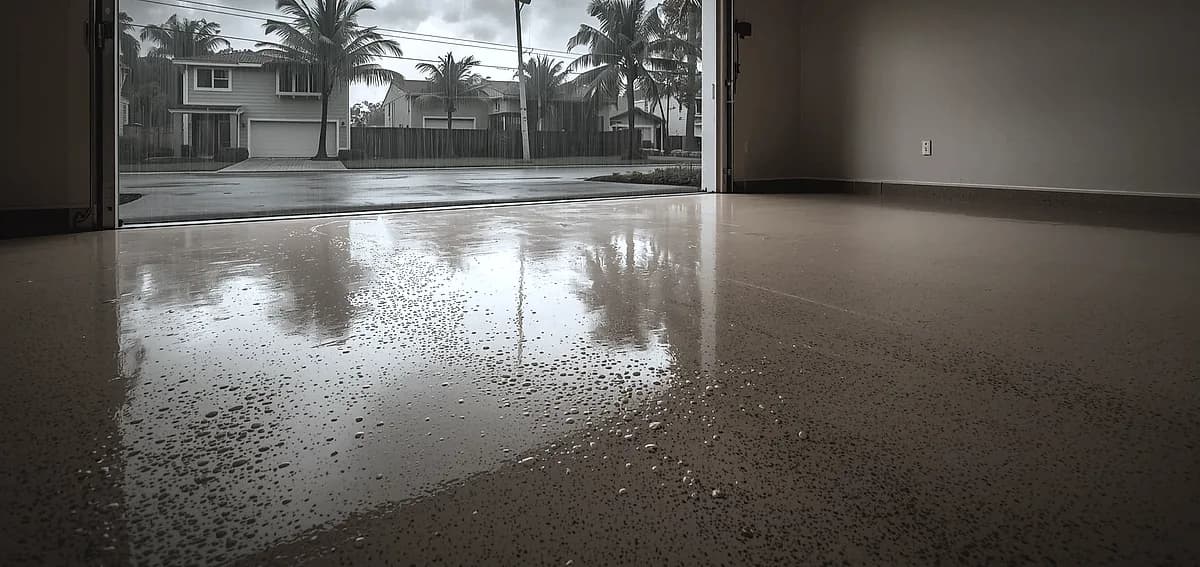
Miami garage floors routinely reach surface temperatures of 110-130°F during summer months. According to the Tile Council of North America, vinyl flooring begins softening at 140°F and experiences permanent deformation above 160°F. Hot tires from vehicles parked in sun-heated driveways frequently exceed these thresholds.
Professional garage floor epoxy systems tolerate surface temperatures up to 200°F without softening or deformation. This explains why epoxy dominates Miami’s garage flooring market while vinyl remains virtually absent from these applications.
UV Exposure and Color Stability
Miami receives approximately 2,900 hours of direct sunlight annually, roughly 30% more than northern U.S. cities. This intense UV exposure accelerates photodegradation in both flooring types, but with different outcomes.
Standard amine-cured epoxies can amber (yellow) when exposed to direct sunlight. However, professional installations use UV-stable polyurethane or polyaspartic topcoats that block UV penetration and maintain color integrity for 15-20 years.
Vinyl flooring lacks similar UV protection options. The wear layer contains UV stabilizers, but these deplete over 3-5 years of Miami sun exposure. Once depleted, vinyl fades, yellows, and becomes brittle. Replacement rather than repair becomes the only solution.
Durability and Lifespan Comparison
Impact and Abrasion Resistance
Epoxy flooring achieves hardness ratings of 75-85 on the Shore D scale, comparable to hard plastics and soft metals. This hardness provides excellent resistance to dropped tools, furniture legs, high heels, and rolling loads like dollies and carts.
The factors affecting epoxy lifespan in Miami include traffic volume, chemical exposure, and maintenance practices. Commercial epoxy installations in high-traffic Miami retail environments maintain appearance and function for 15-20 years with basic maintenance.
Vinyl’s wear layer thickness determines abrasion resistance. Residential vinyl typically has 6-12 mil wear layers, while commercial products feature 20-28 mil layers. Even premium commercial vinyl shows visible wear patterns within 5-7 years under heavy traffic conditions common in Miami retail and hospitality environments.
Repair vs Replacement
Damaged epoxy can be spot-repaired by grinding the affected area and applying new material that chemically bonds to the existing floor. This extends total system life without full replacement. The epoxy repair process typically costs $3-$5 per square foot for affected areas only.
Vinyl damage requires plank or tile replacement. While individual pieces can be swapped, color matching becomes impossible after UV exposure fades the surrounding floor. This creates obvious patch marks that many property owners find unacceptable, forcing complete replacement instead of localized repair.
Installation Requirements in Miami
Surface Preparation
Epoxy installation requires thorough concrete surface profiling to achieve mechanical adhesion. Professional contractors use diamond grinding or shot blasting to create ICRI Concrete Surface Profile (CSP) levels of 2-4. This preparation removes contaminants, opens concrete pores, and creates texture for epoxy bonding.
Vinyl requires minimal subfloor preparation by comparison. A clean, smooth, level surface suffices for most installations. However, this minimal preparation leaves the concrete slab vulnerable to moisture issues that vinyl cannot address.
Climate Control During Installation
Both flooring types require climate control during Miami installations, but for different reasons. Epoxy chemistry depends on temperature and humidity. Most systems require substrate temperatures between 50-90°F and relative humidity below 85% during application and curing.
Understanding how humidity affects epoxy floors helps contractors time installations appropriately. Miami’s dry season (November through April) provides optimal natural conditions, while wet season work requires dehumidification equipment.
Vinyl adhesives also require climate control, primarily to prevent moisture from interfering with bond formation. However, vinyl lacks the ability to receive moisture mitigation treatments, making it inherently more vulnerable to Miami’s humidity even when installation conditions are controlled.
Total Cost of Ownership Analysis
Initial installation costs favor vinyl, but total cost of ownership over 15-20 years often favors epoxy in Miami applications.
| Cost Factor | Epoxy (20 years) | Vinyl (20 years) |
|---|---|---|
| Initial Installation | $8/sq ft | $5/sq ft |
| Replacements Needed | 0 | 2-3 (every 6-8 years) |
| Replacement Costs | $0 | $10-$15/sq ft (x2-3) |
| Annual Maintenance | $0.10/sq ft | $0.25/sq ft |
| 20-Year Total (1,000 sq ft) | $10,000 | $30,000-$50,000 |
For detailed pricing information, see our comprehensive cost to epoxy a floor guide.
Application-Specific Recommendations for Miami
Residential Garages
Winner: Epoxy. The combination of hot tire resistance, chemical resistance for automotive fluids, and moisture vapor blocking makes epoxy the only practical choice. Vinyl would fail within months due to hot tire pickup and adhesive degradation. Explore luxury garage floor options for design inspiration.
Commercial Kitchens and Food Service
Winner: Epoxy. Miami health codes require seamless, non-porous flooring in food preparation areas. Epoxy’s seamless installation eliminates bacterial harborage points where seams would exist with vinyl. Commercial kitchen epoxy systems also resist the thermal shock from hot water and grease that destroys vinyl adhesives.
Retail Spaces and Showrooms
Winner: Epoxy for high-traffic; vinyl acceptable for low-traffic. High-traffic Miami retail environments benefit from epoxy’s superior abrasion resistance and longer lifespan. Lower-traffic boutiques or offices may find vinyl’s lower initial cost attractive, though UV exposure from large windows still accelerates vinyl degradation.
Healthcare Facilities
Winner: Epoxy. Medical facility flooring requires seamless surfaces that prevent microbial growth and withstand aggressive disinfection protocols. Vinyl seams harbor bacteria and adhesives degrade when exposed to hospital-grade cleaners.
Residential Living Spaces
Context-dependent. Air-conditioned Miami homes with consistent climate control can use vinyl in bedrooms and living areas where heat and moisture exposure remain minimal. However, properties with frequent door openings, poor HVAC, or high occupancy still benefit from epoxy or polished concrete alternatives.
Maintenance Requirements Comparison
Epoxy Floor Maintenance
Epoxy floors require minimal maintenance in Miami environments:
Daily: Dust mop or sweep to remove sand and debris tracked in from Miami’s beaches and outdoor areas.
Weekly: Damp mop with pH-neutral cleaner. See our complete epoxy floor cleaning guide for recommended products and techniques.
Annually: Inspection for wear patterns or coating thinning in high-traffic areas. Minor touch-ups as needed.
Every 5-7 years: Optional topcoat refresh to restore gloss and renew UV protection.
Vinyl Floor Maintenance
Vinyl requires more intensive maintenance, particularly in humid environments:
Daily: Sweep and spot clean. Avoid excessive water that can infiltrate seams.
Weekly: Damp mop with vinyl-specific cleaners. Avoid harsh chemicals that damage the wear layer.
Monthly: Inspect seams for lifting or moisture damage. Address immediately to prevent spreading.
Every 1-2 years: Strip old wax and apply fresh protective coating (commercial vinyl).
Every 6-10 years: Complete replacement due to wear, fading, or moisture damage.
Frequently Asked Questions
Is epoxy flooring better than vinyl for Miami homes?
For most Miami applications, yes. Epoxy’s moisture resistance, heat tolerance, and longevity outperform vinyl in South Florida’s demanding climate. The exception is climate-controlled bedrooms and offices in well-sealed homes, where vinyl’s lower initial cost may make sense for budget-conscious homeowners willing to accept shorter replacement cycles.
Can vinyl flooring handle Miami garage temperatures?
No. Vinyl softens and deforms at temperatures above 140°F, and Miami garage floors regularly exceed 110-130°F during summer. Hot tires from sun-heated driveways create localized temperatures that cause immediate vinyl damage. Epoxy is the only practical choice for Miami garage applications.
How long does vinyl last compared to epoxy in Miami?
Vinyl typically lasts 5-10 years in Miami before requiring replacement due to moisture damage, UV degradation, or adhesive failure. Professional epoxy installations last 15-25 years with minimal maintenance. Over a 20-year period, vinyl may require 2-3 replacements while epoxy requires none.
Is vinyl flooring waterproof in humid climates?
Vinyl itself resists water, but vinyl flooring systems are not waterproof. Seams between planks or tiles allow moisture infiltration, and adhesives degrade in humidity above 70%. Miami’s 74-78% average humidity creates conditions that compromise vinyl flooring integrity over time, even in climate-controlled spaces.
Which flooring is easier to maintain in Miami?
Epoxy requires significantly less maintenance. Its seamless surface prevents dirt accumulation in joints, and it never needs waxing or sealing. Vinyl requires regular waxing (commercial applications), careful moisture management at seams, and eventual replacement. Epoxy’s maintenance costs run approximately $0.10/sq ft annually versus $0.25/sq ft for vinyl.
Can I install vinyl over existing epoxy in Miami?
Technically possible but not recommended. Vinyl adhesives bond poorly to cured epoxy surfaces, creating adhesion failures. Additionally, installing vinyl over epoxy sacrifices the moisture barrier benefits that epoxy provides. If changing flooring systems, remove the epoxy completely or apply a new epoxy system with updated aesthetics.
Get Professional Epoxy Flooring in Miami
National Concrete Polishing provides expert epoxy flooring installation throughout Miami-Dade County. Our certified installers understand the unique challenges of South Florida’s tropical climate and use premium materials specifically formulated for high-humidity, high-heat environments.
Every installation includes comprehensive moisture testing, professional surface preparation, and climate-controlled application for guaranteed long-term performance.
Contact our Miami team for a free consultation and estimate. We also serve Fort Lauderdale, Pompano Beach, and all of South Florida.
Written by

Founder and CEO
Chris Lavin is an esteemed leader in concrete polishing and epoxy coatings with a distinguished 20-year career. As founder and CEO of National Concrete Polishing and owner of Xtreme Polishing Systems, he's renowned for polishing and epoxy coating more floors than anyone globally. Chris is recognized for his innovative approach and commitment to enhancing floor durability and aesthetics. His hands-on experience and technical proficiency make him a respected authority and a valuable resource in the field of floor polishing and coatings.
Same topic
Related articles
All stories
Epoxy & coatings8 min read
DIY vs Professional Epoxy Flooring in Fort Lauderdale
Hardware stores heavily market all-in-one boxes that promise a showroom finish with minimal effort.
Read it
Epoxy & coatings8 min read
Can You DIY Epoxy Flooring in Miami? Pros, Cons, and Tips
Applying a durable floor finish in a tropical or highly humid climate presents unique environmental challenges.
Read it
Epoxy & coatings7 min read
DIY Epoxy Flooring in South Florida: Is It Worth the Risk?
However, these products generally contain high levels of water or solvents to extend their pot life.
Read it
Tell us about the floor
Tell us the space and roughly how big it is.We come back with what it would cost and when we could start.
Prefer to talk? Call +1 844-876-5474
- Leads@
nationalconcretepolishing.net - 2200 NW 32nd St #600,
Pompano Beach, FL 33069 Mon to Fri, 9:00 to 5:30