
The NCP blog
How to Start a Concrete Polishing Business in Florida
Polished concrete14 min read
Florida’s concrete polishing market benefits from unique conditions that create exceptional business opportunities.
Starting a concrete polishing business startup in Florida’s booming construction market offers exceptional profit potential, with established companies charging $3-$12 per square foot and completing multiple projects monthly that generate six-figure annual revenues. The Sunshine State’s explosive population growth, extensive commercial development, and year-round construction activity create sustained demand for polished concrete flooring in warehouses, retail spaces, showrooms, and residential properties throughout Miami, Fort Lauderdale, Tampa, and Orlando. However, launching a successful concrete polishing business in Florida requires strategic planning across multiple dimensions from understanding state licensing requirements and investing $50,000-$100,000 in specialized equipment to developing marketing strategies that differentiate your services in competitive markets.
This comprehensive guide walks aspiring entrepreneurs through every critical step of establishing a concrete polishing operation, covering legal compliance, equipment selection, pricing strategies, customer acquisition, and the operational systems that separate profitable companies from struggling startups in Florida’s dynamic construction industry.
Overview
This complete business startup guide provides the roadmap entrepreneurs need to launch profitable concrete polishing companies in Florida. You’ll learn about state-specific licensing and regulatory requirements, essential equipment investments and their costs, business structure decisions, insurance needs, and pricing strategies that ensure profitability. We’ll explore marketing tactics for acquiring commercial and residential clients, hiring and training considerations, quality control systems, and financial projections that help secure funding and measure success.
Understanding the Florida Market Opportunity
Florida’s concrete polishing market benefits from unique conditions that create exceptional business opportunities. The state’s commercial construction spending exceeds $50 billion annually, with warehouse, retail, and industrial facilities representing prime concrete polishing clients. Year-round construction activity eliminates the seasonal downtime that plagues contractors in northern states, allowing consistent revenue generation.
The growing preference for polished concrete over traditional flooring in commercial applications driven by durability, low maintenance, and aesthetic appeal expands market demand beyond replacement cycles. South Florida’s humidity and coastal conditions create challenges for alternative flooring materials that accelerate polished concrete adoption. Major metropolitan areas including Miami-Dade, Broward, Palm Beach, Hillsborough, and Orange Counties concentrate demand where commercial development sustains multiple competing contractors.
Florida Licensing and Legal Requirements
Florida’s regulatory environment for concrete polishing businesses differs from many states, creating lower barriers to entry. No specialized contractor license is required specifically for concrete polishing—only standard business licenses issued by local municipalities. This contrasts with full concrete contracting that requires state licensing through the Department of Business and Professional Regulation. However, expanding services to include concrete installation or structural repairs triggers contractor licensing requirements with experience, examination, and financial responsibility prerequisites.
Business registration involves selecting and registering your company name, choosing business structure (discussed below), and obtaining an Employer Identification Number (EIN) from the IRS. Local business tax receipts (occupational licenses) are required in the county/city where you operate—costs vary but typically range $50-$300 annually. Florida building codes and OSHA regulations govern operational practices, particularly silica dust exposure management on commercial job sites. Violating OSHA silica standards triggers severe penalties that can devastate startup finances—proper dust collection systems and respirators are mandatory, not optional.
Choosing Your Business Structure
Limited Liability Company (LLC) represents the optimal structure for most concrete polishing startups, providing liability protection that shields personal assets from business debts and lawsuits while maintaining tax flexibility. LLCs avoid double taxation that C-corporations face and offer more credibility than sole proprietorships when pursuing commercial contracts. Florida LLC formation costs approximately $125 for state filing fees, with annual reports requiring $138.75 each year to maintain good standing.
Sole proprietorships minimize initial paperwork and costs but expose owners’ personal assets to unlimited business liability—a single lawsuit from job site injury could claim your home and savings. S-corporations provide tax advantages for high-profit operations but require more complex bookkeeping and corporate formalities that add administrative burden. Most successful concrete polishing companies begin as single-member or multi-member LLCs, potentially converting to S-corps after establishing profitability. Consulting with Florida business attorneys and CPAs ensures optimal structure for your specific situation and growth plans.
Essential Insurance Coverage
Comprehensive insurance protects your business from catastrophic financial losses that destroy under-insured contractors. General liability insurance covers third-party bodily injury and property damage—essential when operating heavy equipment in occupied commercial spaces. Policies should provide minimum $1 million per occurrence and $2 million aggregate coverage, costing $1,200-$3,000 annually depending on revenue projections.
Workers’ compensation insurance is mandatory in Florida for businesses with four or more employees, covering medical costs and lost wages from work-related injuries. Concrete polishing involves physical labor and equipment operation that create injury risks—workers’ comp premiums typically run 8-15% of payroll for construction trades. Commercial auto insurance covers vehicles and equipment trailers, while equipment/tool insurance protects against theft or damage to expensive grinding machines and generators. Many commercial clients require certificates of insurance before allowing contractors on site—inadequate coverage eliminates bidding opportunities on lucrative projects.
Equipment Investment and Costs
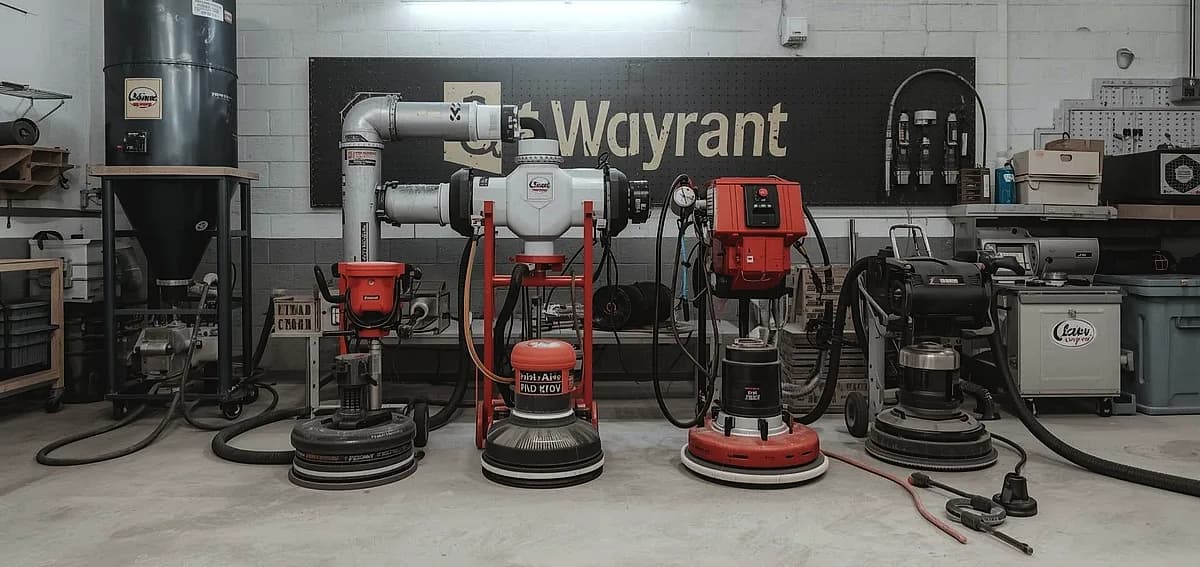
Professional concrete polishing requires significant upfront equipment investment that separates serious operations from inadequately equipped competitors. Primary grinding equipment includes 20-inch or larger planetary grinders capable of 200-450 square feet per hour production rates, costing $15,000-$30,000 depending on brand and features. Leading manufacturers like HTC, Husqvarna, Werkmaster, and Lavina produce reliable machines that withstand demanding commercial use.
Diamond tooling inventory represents ongoing expenses as grinding pads wear based on concrete hardness and aggregate exposure. Startup tooling packages including various grit levels (30, 50, 100, 200, 400, 800, 1500, 3000) cost $3,000-$5,000 initially. PCD (polycrystalline diamond) tooling removes existing coatings and adhesives, essential for retrofit projects—initial sets run $800-$1,500. High-capacity HEPA vacuum systems complying with OSHA silica standards cost $3,000-$8,000 depending on CFM ratings.
Supporting equipment includes 13,000+ watt generators ($2,000-$4,000), extension cords, handheld grinders for edges ($500-$1,500), moisture testing equipment ($400-$800), and concrete densifiers and sealers. Total equipment investment typically ranges $50,000-$100,000 for operations equipped to handle commercial projects professionally. Used equipment reduces initial costs but carries reliability risks that can derail early projects.
Vehicle and Transportation Requirements
Reliable transportation represents critical infrastructure for job site access and equipment mobility. Commercial-grade pickup trucks or cargo vans capable of towing equipment trailers cost $30,000-$60,000 new, $15,000-$35,000 used. Enclosed trailers (14-16 feet) protecting expensive equipment from weather and theft run $5,000-$12,000 new. Total transportation investment including commercial auto insurance typically consumes $20,000-$40,000 of startup capital.
Proper vehicle selection impacts operational efficiency—adequate towing capacity (minimum 7,500 pounds) and payload ratings prevent mechanical failures that strand crews at job sites. Enclosed trailers provide mobile storage that eliminates daily loading/unloading cycles, improving productivity. Professional branding with company name, phone number, and website on vehicles creates moving billboards generating leads as you travel to job sites—vinyl graphics cost $1,500-$3,000 but deliver ongoing marketing value.
Training and Skill Development
Technical competence separates contractors who produce stunning results from those whose work fails prematurely. Understanding concrete polishing diamond grit sequences and proper grinding techniques is essential—mistakes cannot be easily corrected once concrete is exposed. Many equipment manufacturers offer training programs teaching proper machine operation, tooling selection, and troubleshooting common issues.
Industry organizations including the Concrete Polishing Association of America (CPAA) provide certification programs validating technical knowledge to skeptical clients. Hands-on experience on low-stakes projects (personal garages, storage sheds) builds confidence before bidding commercial jobs where errors cost thousands in remediation. Understanding concrete surface profile requirements, moisture testing protocols, and densifier application techniques prevents costly failures that damage reputation before businesses establish track records.
Developing Your Service Menu
Strategic service selection balances revenue potential against complexity and competition. Basic polished concrete represents core offerings—grinding existing slabs through progressive diamond grits to achieve desired gloss levels. This straightforward service suits warehouses, manufacturing facilities, and retail showrooms prioritizing functionality over decoration.
Decorative polishing incorporating stains, dyes, saw-cut patterns, or exposed aggregate commands premium pricing ($8-$15/sf) but requires artistic sensibility and advanced technical skills. Restoration services reviving worn or damaged existing polished concrete tap into maintenance cycles at established facilities—this recurring revenue complements new construction projects. Some contractors expand into complementary services like epoxy coating or concrete resurfacing to capture additional project scope, though this may require specialized licensing depending on work performed.
Pricing Strategies and Profit Margins
Professional concrete polishing pricing balances competitive positioning against profitability requirements. Standard polished concrete typically ranges $3-$7 per square foot for basic grinding and densifying on good substrate conditions. Decorative applications with stains, dyes, or complex patterns command $8-$15 per square foot depending on customization level. Difficult conditions including heavy coating removal, extensive repairs, or moisture mitigation justify premium pricing $10-$20+ per square foot.
Successful pricing requires accurate job estimation accounting for substrate condition, surface preparation requirements, square footage, access challenges, and desired finish quality. Under-bidding to win early projects creates unsustainable operations that fail once fixed costs accumulate. Target profit margins of 30-40% after direct costs (labor, materials, equipment wear) ensure adequate returns covering overhead, marketing, and owner compensation. Larger commercial projects (10,000+ square feet) support lower per-square-foot pricing through economies of scale, while smaller residential jobs require higher rates to justify mobilization costs.
Marketing and Lead Generation Strategies
Effective marketing distinguishes thriving businesses from those struggling for clients in competitive markets. Commercial construction relationships provide the most reliable lead sources—general contractors, developers, and architects specify flooring on projects valued in millions. Joining bid lists, attending industry events, and cultivating relationships with decision-makers at commercial construction firms generates steady project flow.
Digital marketing establishes online presence that captures inbound leads from property managers and facility owners researching flooring options. Professional websites showcasing completed projects with before/after photos, detailed service descriptions, and clear contact information convert visitors into inquiries. Google Business Profile optimization ensures your company appears when prospects search “concrete polishing near me” or “polished concrete contractors [Florida city].” Social media platforms particularly Instagram and Facebook provide visual mediums perfect for showcasing stunning polished concrete transformations.
Networking and referrals from satisfied clients drive sustainable growth without marketing expenses—deliver exceptional results that exceed expectations, then request reviews and referrals. Industry associations including local builders’ exchanges, construction trade groups, and chambers of commerce provide networking opportunities connecting contractors with potential clients. Vehicle branding and signage at job sites creates awareness in areas where commercial decision-makers work and travel.
Targeting Commercial vs Residential Markets
Commercial projects offer superior revenue potential with larger square footage, higher total values, and less price sensitivity than residential work. Warehouses, retail stores, office buildings, and industrial facilities routinely install 20,000-100,000+ square feet of polished concrete in single projects. However, commercial work involves complex bidding processes, longer payment cycles (30-90 days), and stringent insurance/bonding requirements that challenge undercapitalized startups.
Residential projects including garage floors, basements, and living spaces offer faster payment, simpler sales processes, and fewer bureaucratic hurdles. Typical residential jobs (400-1,000 square feet) complete quickly but generate lower total revenue than commercial contracts. Many successful companies pursue hybrid strategies serving commercial contracts as primary revenue while filling scheduling gaps with residential work. High-end residential projects in affluent Florida markets justify premium pricing and showcase decorative capabilities that attract additional luxury clients.
Building Your Team
Solo operations limit growth potential—scaling profitable businesses requires hiring and managing employees. Initial hires should possess physical stamina for labor-intensive grinding work, mechanical aptitude for equipment operation, and reliability for showing up consistently. Florida’s construction labor market offers both opportunities and challenges—abundant workforce availability competes with other contractors recruiting the same talent pool.
Starting with one or two laborers allows manageable growth while owner-operators maintain hands-on quality control and customer relationships. As revenue increases, adding experienced polishing technicians with prior flooring experience accelerates production and reduces training burden. Eventually, hiring project managers who handle estimating, scheduling, and client communication frees owners to focus on business development and strategic planning. Competitive wages, consistent work schedules, and clear advancement paths reduce turnover that derails productivity.
Operational Systems and Processes
Systematic operations separate professional companies from disorganized competitors. Estimating systems that accurately predict labor hours, material consumption, and equipment wear prevent unprofitable bids that win work but lose money. Detailed checklists covering surface preparation steps, diamond grit sequences, and quality standards ensure consistent results regardless of which crew member executes the work.
Project management tools coordinate scheduling, track material usage, document progress photos, and manage client communications. Financial systems including accounting software (QuickBooks, Xero) track income, expenses, profitability by project, and tax obligations. Inventory management maintains adequate tooling supplies without tying up excessive capital in unused diamonds. Safety protocols covering silica dust exposure, equipment operation, and job site hazards protect employees while reducing workers’ compensation claims that increase insurance premiums.
Quality Control and Customer Satisfaction
Reputation determines long-term success in construction trades where referrals and repeat clients drive revenue. Pre-project consultations set realistic expectations about achievable results given existing substrate conditions—promising outcomes that concrete cannot deliver guarantees dissatisfied clients. Thorough concrete assessment including moisture testing prevents surprises mid-project that delay completion or compromise quality.
In-process quality checks verify proper grinding sequences, uniform appearance, and desired gloss levels before moving to next phases. Final inspections with clients identify concerns before demobilizing from job sites—addressing issues immediately costs less than return trips after equipment is stored. Post-project follow-up within weeks ensures satisfaction and requests reviews/referrals when clients are most enthusiastic. Warranty programs covering workmanship for specified periods demonstrate confidence and differentiate from fly-by-night competitors avoiding responsibility for failures.
Financial Planning and Funding
Realistic financial projections guide decisions and secure funding from lenders or investors. Startup costs including equipment ($50,000-$100,000), vehicle/trailer ($20,000-$40,000), insurance ($5,000-$8,000), licensing/legal ($2,000-$5,000), initial marketing ($3,000-$8,000), and working capital ($15,000-$25,000) total $95,000-$186,000 depending on scale and equipment choices. This substantial investment explains why many startups fail—undercapitalization prevents purchasing proper equipment or surviving initial slow periods.
Funding sources include personal savings, business loans, SBA loans with favorable terms for small businesses, equipment financing spreading purchases over time, and partner investments from co-owners sharing startup costs. First-year revenue projections should account for ramp-up periods—assuming full schedules from day one ignores market penetration realities. Conservative projections billing 800-1,200 hours annually at $100-$150/hour (translating to $4-$8/sf pricing on various project sizes) generate $80,000-$180,000 gross revenue, less labor, materials, overhead yielding $30,000-$75,000 net profit for owner-operators who minimize overhead expenses.
Common Startup Mistakes to Avoid
Learning from others’ failures prevents repeating expensive mistakes. Inadequate equipment compromises results and frustrates clients—budget grinders cannot achieve the finishes professional machinery delivers. Under-pricing to win early work establishes unsustainable rates that clients expect continued, while profits fail to cover fixed costs. Poor cash flow management including net-30 or net-60 payment terms without adequate working capital creates situations where payroll cannot be met despite outstanding receivables.
Neglecting marketing assumes projects will appear through word-of-mouth alone—this passive approach leaves calendars empty while competitors actively pursue clients. Skipping proper training on equipment and techniques produces inconsistent results that damage reputation before it’s established. Ignoring OSHA compliance particularly silica dust regulations triggers devastating fines that bankrupt startups. Inadequate insurance creates catastrophic exposure where single lawsuits claim all business and personal assets.
Growth Strategies and Scaling
Once operations stabilize, strategic growth expands revenue and profitability. Geographic expansion into adjacent counties and metropolitan areas multiplies addressable market without changing service offerings. Service diversification into complementary offerings like epoxy coating, concrete resurfacing, or decorative concrete captures additional project scope from existing clients. Commercial specialization in specific niches like warehouses, retail, or hospitality develops expertise and relationships that command premium pricing.
Multiple crews amplify production capacity—second and third crews allow simultaneous projects that dramatically increase monthly revenue. Equipment investment in newer, faster machinery reduces labor hours per square foot, improving profitability even at competitive pricing. Strategic partnerships with general contractors, architects, and property management firms create preferred vendor relationships generating consistent project flow. Brand building through industry awards, media coverage, and prominent projects establishes market leadership that justifies premium positioning.
Frequently Asked Questions
Do I need a special license to polish concrete in Florida?
No, Florida doesn’t require specialized contractor licenses specifically for concrete polishing—only standard business licenses and adherence to OSHA regulations for commercial work.
How much does it cost to start a concrete polishing business?
Initial startup costs range $95,000-$186,000 including equipment ($50,000-$100,000), vehicles, insurance, and working capital.
What equipment do I need for concrete polishing?
Essential equipment includes 20″+ planetary grinder, diamond tooling in multiple grits, high-capacity HEPA vacuum, generator, handheld edgers, and moisture testing equipment.
How much can I charge for concrete polishing in Florida?
Standard polished concrete ranges $3-$7/sf for basic work, $8-$15/sf for decorative applications, depending on complexity and substrate conditions.
Is OSHA compliance required for concrete polishing?
Yes, commercial projects must comply with OSHA silica dust regulations requiring proper dust collection systems and respiratory protection.
What insurance do concrete polishing businesses need?
General liability ($1M/$2M minimum), workers’ compensation if employing staff, commercial auto, and equipment insurance are essential.
Should I target commercial or residential clients?
Commercial projects offer larger revenue but complex bidding; residential provides faster payment and simpler sales—many successful companies pursue hybrid strategies.
How long does it take to become profitable?
Most businesses achieve profitability within 6-18 months once marketing generates consistent projects and operations become efficient at execution.
Can I start part-time while keeping my job?
Part-time starts are challenging given equipment investment and client scheduling demands—most successful companies require full-time commitment from launch.
What’s the profit margin in concrete polishing?
Target 30-40% profit margins after direct costs; successful established companies achieve 40-50% margins through operational efficiency and premium positioning.
Conclusion
Starting a concrete polishing business in Florida offers exceptional opportunities for entrepreneurs willing to make substantial equipment investments, master technical skills, and execute strategic marketing that penetrates competitive markets. The state’s favorable regulatory environment requiring no specialized licenses for polishing, combined with year-round construction activity and explosive commercial development, creates ideal conditions for profitable operations. However, success demands avoiding common startup mistakes including under-capitalization, inadequate equipment, poor pricing strategies, and OSHA compliance failures that destroy underprepared competitors. By following this comprehensive roadmap from securing proper business structure and insurance through investing in quality equipment, developing systematic operations, and implementing effective marketing aspiring contractors can build thriving businesses that capitalize on Florida’s robust demand for polished concrete flooring across commercial and residential sectors.
National Concrete Polishing demonstrates what’s possible when technical excellence, strategic business practices, and commitment to customer satisfaction combine creating a leading concrete polishing operation serving Pompano Beach, Fort Lauderdale, Miami, and surrounding South Florida markets. Contact us to discuss mentorship opportunities or partnership possibilities for motivated entrepreneurs entering this dynamic industry.
Written by

Founder and CEO
Chris Lavin is an esteemed leader in concrete polishing and epoxy coatings with a distinguished 20-year career. As founder and CEO of National Concrete Polishing and owner of Xtreme Polishing Systems, he's renowned for polishing and epoxy coating more floors than anyone globally. Chris is recognized for his innovative approach and commitment to enhancing floor durability and aesthetics. His hands-on experience and technical proficiency make him a respected authority and a valuable resource in the field of floor polishing and coatings.
Same topic
Related articles
All stories
Polished concrete11 min read
Polished Concrete vs Epoxy Coatings: Which Floor Is Right for Your Space?
Two systems, two price curves, one slab. What each one costs to install and to keep, and which spaces each one actually suits.
Read it
Polished concrete8 min read
What to Know Before Polishing Your Existing Concrete Slab
Before any mechanical refinement can begin, a thorough evaluation of the current foundation is required.
Read it
Polished concrete8 min read
Is Polished Concrete Worth the Investment for Miami Properties?
It is essential to distinguish between a simple topical seal and mechanically refined concrete.
Read it
Tell us about the floor
Tell us the space and roughly how big it is.We come back with what it would cost and when we could start.
Prefer to talk? Call +1 844-876-5474
- Leads@
nationalconcretepolishing.net - 2200 NW 32nd St #600,
Pompano Beach, FL 33069 Mon to Fri, 9:00 to 5:30